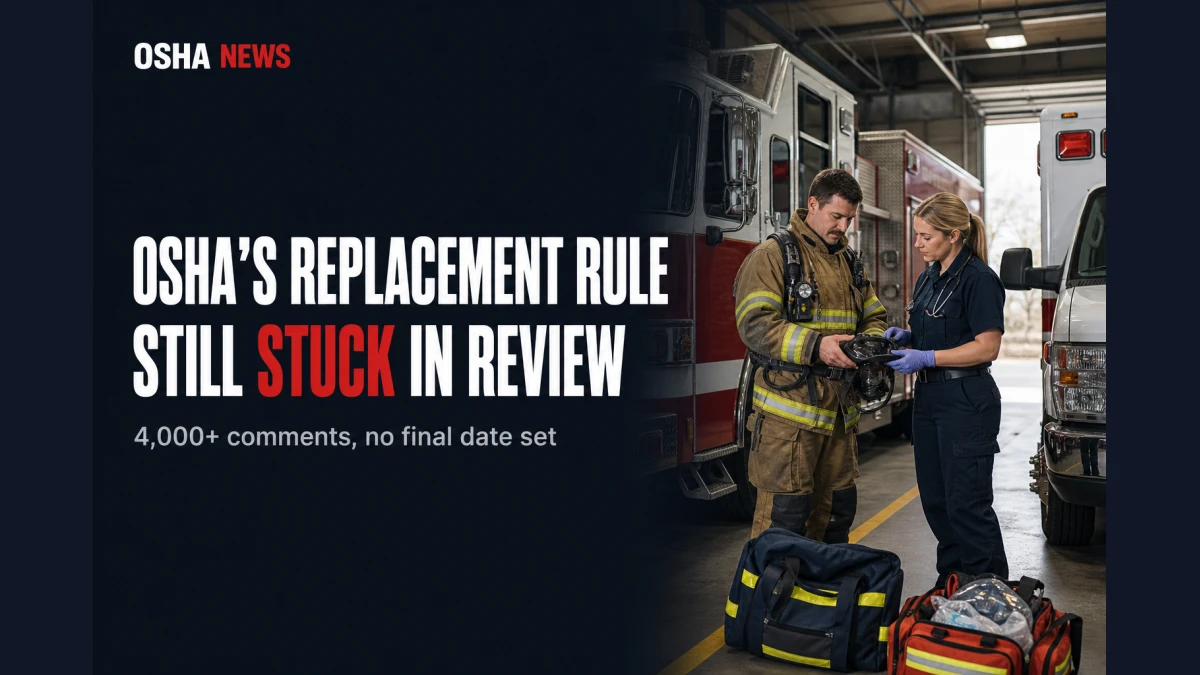
OSHA's proposed Emergency Response standard, meant to replace the agency's Fire Brigades rule written in 1980, has been in review for nearly two years with no final version yet. The agency closed 11 days of public hearings in December 2024 and is now working through more than 4,000 written comments before deciding how to proceed.
What the New Rule Would Cover
The current standard, 29 CFR 1910.156, has only had minor updates since it was first written in 1980 and applies narrowly to organized employer fire brigades, covering training, personal protective equipment, and the written organizational statement a fire brigade has to maintain. OSHA's proposed replacement would keep that core structure but extend coverage for the first time to emergency medical services (EMS) providers and technical search and rescue teams, groups the current rule does not address at all.
The U.S. Fire Administration estimates the new standard would bring roughly 1 million emergency response workers into scope, including about 300,000 volunteer responders covered under certain state laws. In OSHA-approved state-plan states, that scope also extends to public and municipal fire departments, which federal OSHA does not otherwise reach directly.
Why the Rule Is Taking This Long
OSHA published the proposed rule in February 2024. Informal public hearings ran 11 days between November and December 2024, after which the agency said it received additional written comments and data responding to the hearing testimony on top of the formal comment period. As of OSHA's own rulemaking page, the agency is still evaluating more than 4,000 comments and has not set a final rule date.
Industry trackers following the regulatory agenda have reported a target of around April 2027 for a final rule, more than three years after the proposal was published, per AIHA's coverage of OSHA's mid-2026 regulatory agenda update. That date is a projection, not a commitment, and OSHA rulemaking timelines have slipped before.
The Old Standard Still Has Teeth
A pending replacement has not paused enforcement of the current rule. In OSHA News' own enforcement database, 1910.156 has drawn 236 citations and more than $201,000 in penalties since the start of 2024, the same period the rulemaking has been in review, including 195 serious violations, 24 other-than-serious citations, and 17 repeat citations. Going back through OSHA's full inspection history, the standard has drawn 5,874 citations and nearly $1.92 million in penalties total, with the most recent citation issued September 18, 2026.
Employers who operate fire brigades, in other words, are still bound by the 1980-era rule exactly as written, regardless of what a final Emergency Response standard eventually requires.
What Happens Next
Nothing changes for covered employers until OSHA issues a final rule, which the agency has not scheduled with a firm date. When a final rule does arrive, it will likely include a compliance phase-in period, consistent with how OSHA has handled other major standard rewrites. Until then, fire brigades remain governed by 29 CFR 1910.156 as it has existed since 1980, and the roughly 1 million EMS and search-and-rescue workers the new rule would newly cover remain outside a dedicated OSHA standard.