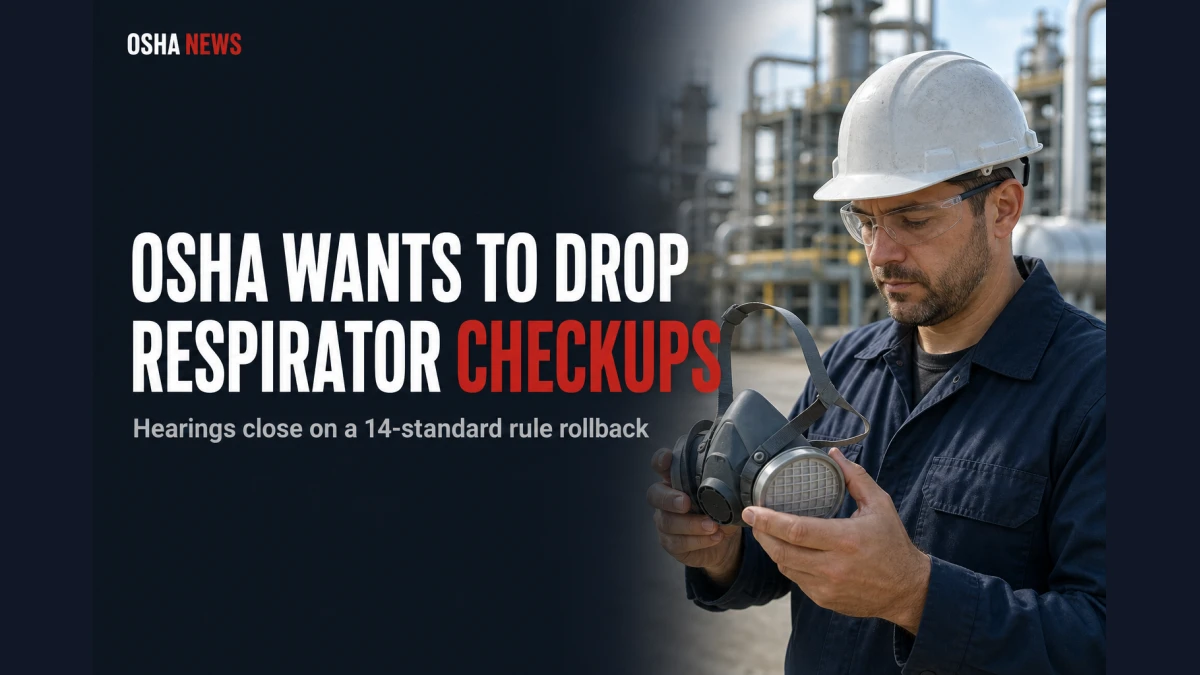
OSHA's informal public hearings on a package of deregulatory rule changes concluded August 26, 2026. The centerpiece is a proposal to eliminate medical evaluation requirements for employees who wear filtering facepiece respirators or loose-fitting powered air-purifying respirators, paired with changes to respirator provisions written into 14 separate substance-specific standards, covering chemicals from asbestos to benzene to formaldehyde, that would fold those standards' own respirator rules into the general standard instead of keeping them separate.
A 23-Rule Package Built Around One Executive Order
OSHA's proposals trace to Executive Order 14192, "Unleashing Prosperity Through Deregulation," which directs federal agencies to streamline or repeal duplicative regulation. OSHA's package, first published in the Federal Register on July 1, 2025 and expanded on April 6, 2026, bundles 23 separate proposed rule changes. Most address respirators, but a handful cover other ground, rescinding the healthcare COVID-19 emergency temporary standard, removing a 2036 deadline for personal fall arrest systems on fixed ladders, and eliminating the safety color-code marking standards for textiles, sawmills, and shipyard employment. Fourteen of the 23 proposals revise respirator requirements written into individual substance-specific standards.
What Would Actually Change
The core change amends 29 CFR 1910.134, the general Respiratory Protection Standard, to remove the medical evaluation requirement specifically for employees who wear filtering facepiece respirators or loose-fitting powered air-purifying respirators. OSHA's proposal cites insufficient evidence that the evaluation prevents health impairment for those two respirator types. The other 14 proposals adjust individual chemical standards, covering asbestos, benzene, lead, cadmium, formaldehyde, vinyl chloride, acrylonitrile, 1,3-butadiene, coke oven emissions, cotton dust, ethylene oxide, inorganic arsenic, methylene chloride, and methylenedianiline, so each one defers to the general Respiratory Protection Standard's requirements instead of keeping its own separate respirator language.
The Advisory Committee Did Not Agree on All of It
In July 2026, the Advisory Committee on Construction Safety and Health reviewed the chemical-specific proposals and split its recommendation. It advised OSHA not to proceed on four of them, acrylonitrile, 1,2-dibromo-3-chloropropane, vinyl chloride, and methylene chloride, while supporting the proposals for methylenedianiline, benzene, ethylene oxide, 1,3-butadiene, inorganic arsenic, cadmium, lead, asbestos, and formaldehyde. The committee also recommended OSHA keep HEPA filter requirements in place for some of those substances even where it supported other streamlining, according to AIHA's reporting. OSHA reopened the affected rulemaking records that same month to reflect the committee's input, ahead of the public hearings.
Where It Stands Now
OSHA held informal virtual public hearings on the full package between August 19 and August 26, 2026, with the hearing on the 16-chemical respirator proposals specifically held August 25. According to OSHA's own deregulatory rulemaking status page, those hearings have concluded and the post-hearing comment periods for anyone who filed a notice to appear have since closed. No final rule has been issued on any of the 14 chemical-specific proposals or the core 1910.134 medical-evaluation change. Until one is, every existing medical evaluation and respirator requirement stays in force exactly as written.
What Our Own Enforcement Data Shows
29 CFR 1910.134 is one of OSHA's most heavily enforced standards. Our full historical database shows 327,275 citations and $104,873,694 in penalties under it, and it's still drawing active enforcement, 3,249 citations and $5,663,345 in penalties so far in FY2026 alone, through the most recent data available. Among the individual chemical standards in the package, lead (29 CFR 1910.1025) carries 85,799 citations and $39,201,126 in penalties in our data, asbestos (29 CFR 1910.1001) carries 30,345 citations and $10,836,183, and formaldehyde (29 CFR 1910.1048) carries 11,369 citations and $4,620,213. Whatever OSHA ultimately decides, these are not rarely used standards sitting on paper. They are some of the standards inspectors cite most.