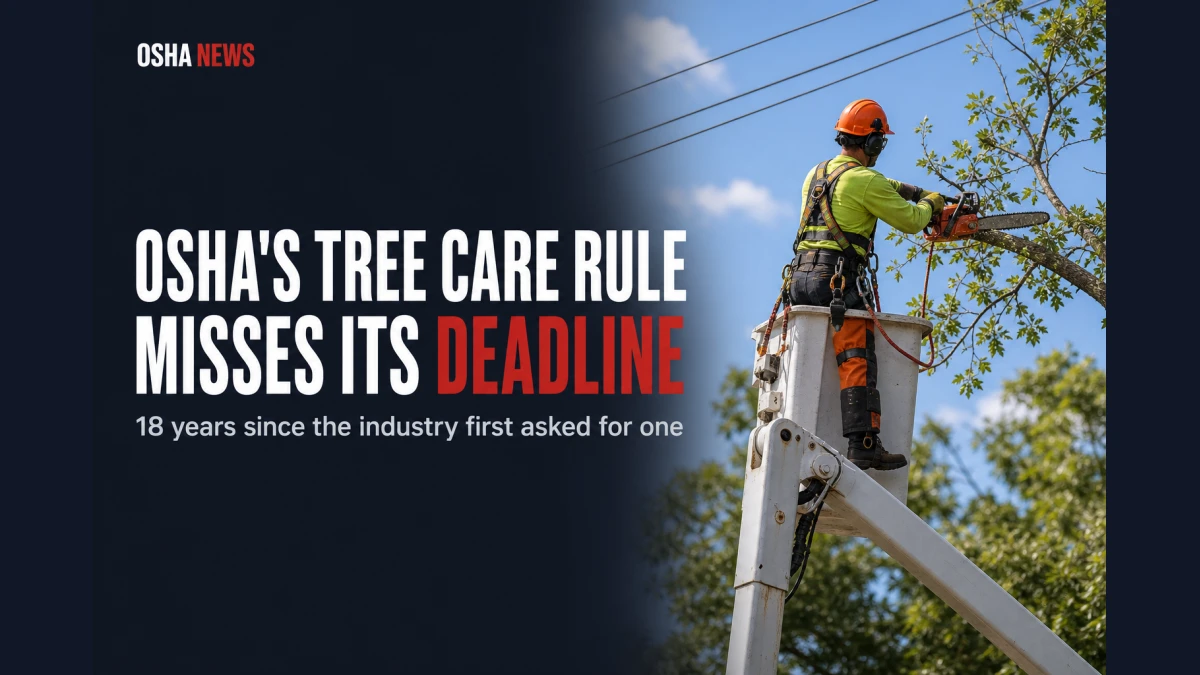
Commercial tree care, pruning, removing, and maintaining trees near power lines, roads, and buildings, is one of the most dangerous jobs OSHA regulates without a standard written specifically for it. OSHA's own 2026 Regulatory Agenda projected a proposed Tree Care Operations rule for October 2026. That month has passed. As of the Tree Care Industry Association's own November 20, 2026 update to Congress, the industry's chief advocacy group still describes the profession as one that "remains one of the most hazardous professions in America, yet still lacks a dedicated federal OSHA Tree Care Operations Standard."
A Rulemaking Nearly Two Decades in the Making
OSHA first opened this question to the public on September 18, 2008, with an Advance Notice of Proposed Rulemaking asking what a tree care standard should cover. Nothing happened quickly. OSHA didn't complete the next required procedural step, a Small Business Advocacy Review panel under the Small Business Regulatory Enforcement Fairness Act, until teleconferences held in April and May of 2020, twelve years after the original notice.
Momentum picked up in 2026. OSHA's Advisory Committee on Construction Safety and Health unanimously recommended the agency move forward with a dedicated standard, a recommendation TCIA reported in June. The agency's own July 2026 Regulatory Agenda then listed a specific target: publish the proposed rule by October 2026. TCIA itself flagged the risk that the date could slip "until after the November midterm elections." It has. OSHA has not published a Notice of Proposed Rulemaking for tree care operations as of this writing.
Why There's Still No Standard of Its Own
In the absence of a dedicated rule, OSHA evaluates tree care work against the ANSI Z133 voluntary consensus standard, now in its 2026 edition, along with whatever general industry or construction standards happen to apply, personal protective equipment, hazard communication, aerial lift inspection, and electrical safety rules written for other industries, not arboriculture specifically. None of those is tailored to the actual hazards of working in a tree canopy near energized lines with a chainsaw.
OSHA's enforcement data shows what that gap looks like in practice. There's no dedicated industry code for "tree care" either; the closest match, NAICS 561730, Landscaping Services, is broader than tree care alone but is the category OSHA itself uses to classify these employers. In our own database, that category covers 19,982 inspections since 1988, with 37,704 total violations and $41,467,601.94 in penalties.
What Our Own Enforcement Data Shows
The single most-cited code against landscaping and tree care employers in our database isn't a specific OSHA standard at all. It's the General Duty Clause, OSH Act Section 5(a)(1), the catch-all provision OSHA uses to cite a hazard when no specific standard addresses it directly. It appears 1,165 times in our data for this industry, totaling $4,365,953.11 in penalties, more citations and more in penalties than any single dedicated CFR standard we track for this group of employers. Hazard Communication is the next most common, cited 917 times, followed by general personal protective equipment requirements.
A code built for hazards no specific rule covers being the top citation against an entire industry is itself a sign of the gap a dedicated standard is meant to close. Behind those citations, OSHA's own accident records tie at least 234 workplace fatalities to inspections at landscaping and tree care employers since the start of 2023 alone, using the accident-to-inspection bridge in the agency's own data. That figure almost certainly understates the true total, since not every fatal accident in this industry results in an OSHA inspection that can be matched back to a specific case.
What Happens Next
A rule entering the Unified Regulatory Agenda with a projected date is not a commitment to a specific publication date, and OSHA's own history with this rulemaking, 18 years from initial notice to a still-unpublished proposal, is a case study in how long these timelines can stretch. The draft rule would still need to clear review by OSHA's own legal staff and the White House Office of Management and Budget before public comment can even begin, procedural steps TCIA's own update acknowledged remained ahead as of July 2026. Until a Notice of Proposed Rulemaking actually publishes, tree care work in the United States continues to be judged against a voluntary industry standard and a collection of rules written for other jobs.