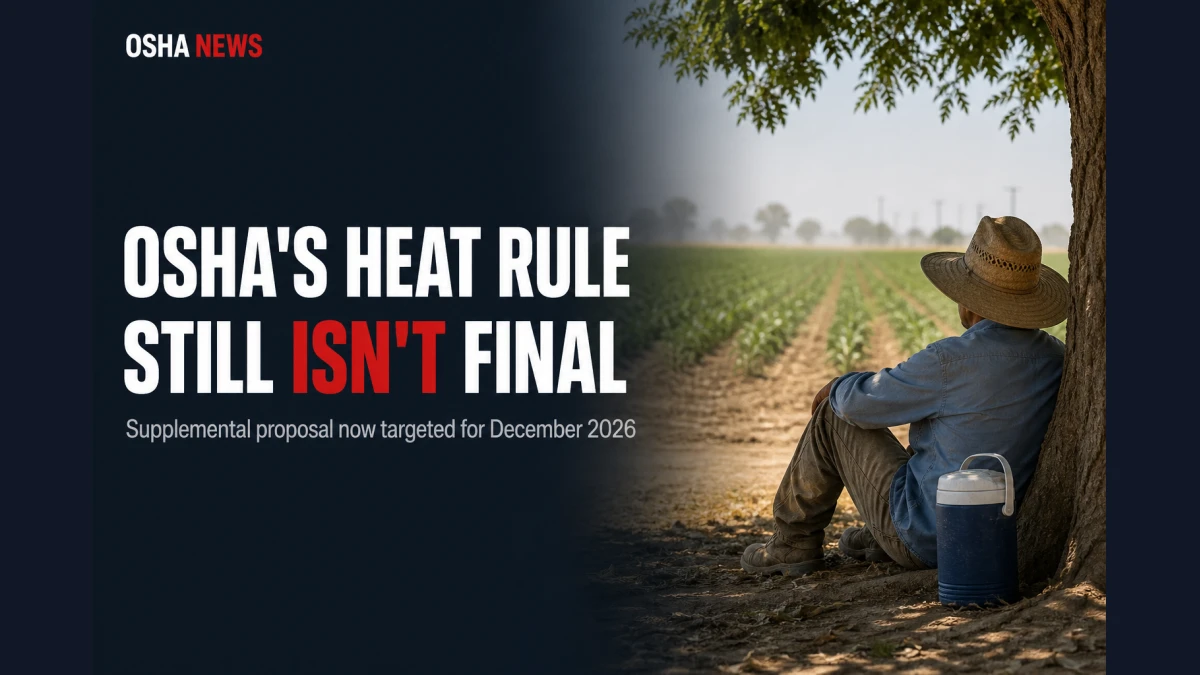
OSHA's proposed federal heat injury and illness prevention rule is not close to final, and the agency's own regulatory agenda now points to a step that pushes it further out, not closer in.
Where This Started
OSHA published its Notice of Proposed Rulemaking, "Heat Injury and Illness Prevention in Outdoor and Indoor Work Settings," on August 30, 2024. That proposal would have required covered employers to develop a written heat injury and illness prevention plan, identify heat hazards, and provide specific protective measures, water, rest breaks, shade or cooling areas, and acclimatization periods for new or returning workers, once heat index or temperature thresholds were met.
Why a Supplemental Proposal, Not a Final Rule
A supplemental proposed rule is not the normal next step after a public comment period closes. OSHA reaches for one specifically when the rule it intends to finalize would look meaningfully different from what it originally proposed, different enough that the agency has to give the public a new chance to comment on the revised version before finalizing anything. The Department of Labor's 2026 regulatory plan lists this supplemental proposal, under RIN 1218-AD39, for December 2026, with the agency's stated goal of scaling back some of the burdens commenters flagged in the original proposal. Final action is currently listed for October 2027, more than three years after the original proposal was published.
What Happens Between Now and a Final Rule
A supplemental proposal has to clear White House Office of Management and Budget review before it publishes, then go through its own public comment period, then have those comments analyzed and written into final regulatory text, then clear OMB review again before anything is finalized. Each of those steps takes real time, which is part of why the timeline moved from an original final-rule expectation to a 2027 target.
OSHA Isn't Waiting to Enforce Heat Hazards
The absence of a final rule doesn't mean heat hazards go uncited in the meantime. OSHA already has a tool for this: the General Duty Clause, Section 5(a)(1) of the OSH Act, which lets the agency cite an employer for a recognized hazard even without a standard written specifically for it. The agency also just revised its National Emphasis Program targeting heat hazards, covered separately, which directs programmed inspections to 55 high-risk industries whenever the National Weather Service issues a local heat warning or advisory. In our own database, General Duty Clause citations whose narrative specifically references heat illness or heat stress total 656 cases and 758 citations, more than $3.28 million in penalties, real enforcement activity happening years before any dedicated heat standard would take effect.
The Practical Takeaway
An employer waiting for a final heat standard to tell them what's required is working from the wrong assumption. The rule itself is still years from finalization at the earliest currently projected timeline, but citation exposure under the General Duty Clause, combined with a Heat NEP that now explicitly flags heat warnings as an inspection trigger, means the practical compliance bar is already higher than "no standard exists yet" would suggest.