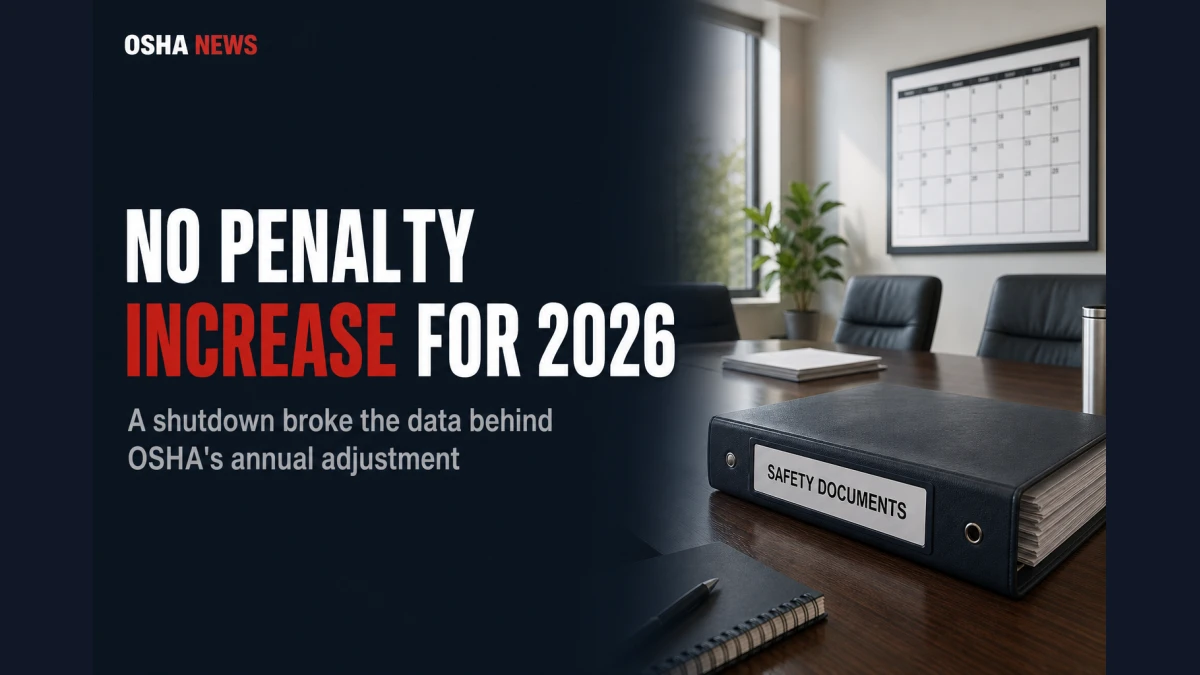
For the first time since Congress required annual inflation adjustments in 2015, OSHA's maximum civil penalties will not increase for 2026. The reason has nothing to do with workplace safety policy: a government shutdown over a year earlier broke the data pipeline the adjustment formula depends on, and by the time anyone could fix it, the window to calculate a 2026 increase had already closed.
What OSHA Actually Announced
In a memorandum dated May 21, 2026, the Department of Labor confirmed there will be no inflation-based increase to OSHA's civil penalties for 2026. The maximum penalty for a Serious, Other-Than-Serious, or Posting-Requirement violation stays at $16,550 per violation. The maximum for a Willful or Repeat violation stays at $165,514 per violation. Failure-to-abate penalties stay at $16,550 per day, generally capped around 30 days. Every one of those figures is identical to the 2025 amounts, carried forward unchanged.
Why a 2025 Shutdown Broke a 2026 Formula
The annual adjustment isn't discretionary. Under the Federal Civil Penalties Inflation Adjustment Act Improvements Act of 2015, OSHA has to recalculate its maximum penalties every year using a specific input: October Consumer Price Index for All Urban Consumers (CPI-U) data published by the Bureau of Labor Statistics. The law doesn't offer a substitute calculation if that data isn't available, it requires that exact figure.
The lapse in federal appropriations in early October 2025 shut down the Bureau of Labor Statistics long enough that it could not produce the required October 2025 CPI-U data at all. Per OMB Memorandum M-26-11, which formally canceled the 2026 penalty inflation adjustments agency-wide, there was simply no number to plug into the formula. A budget standoff that had nothing to do with workplace safety ended up freezing the one enforcement lever that exists specifically to keep OSHA's penalties from losing value to inflation.
What These Numbers Look Like in Real Cases
Abstract maximums are easy to read past. In our own enforcement database, 1,266 citations currently sit at exactly $16,550, the ceiling for a Serious violation, and 164 sit at or above $165,514, the Willful/Repeat ceiling. Those aren't rounding errors or coincidences, they're citations where OSHA's investigator determined the violation warranted the maximum penalty the law allows, and the number landed exactly where the statute caps it.
A steel erection crew in Potterville, Michigan is a recent example of what the Willful ceiling actually produces in practice: every citation OSHA issued in that case was classified Willful, with no lesser classification included at all, for a combined $210,000 across multiple citations at or near the per-violation maximum.
What Doesn't Change
A frozen maximum penalty is not the same as reduced enforcement. OSHA can still cite a Willful or Repeat violation at up to $165,514 per violation in 2026, the same as it could in 2025, it simply won't be a higher number than last year. OSHA's own civil penalty structure explains how a violation gets classified in the first place, which is the decision that actually determines what penalty tier applies, long before the inflation-adjusted ceiling for that tier ever comes into play.