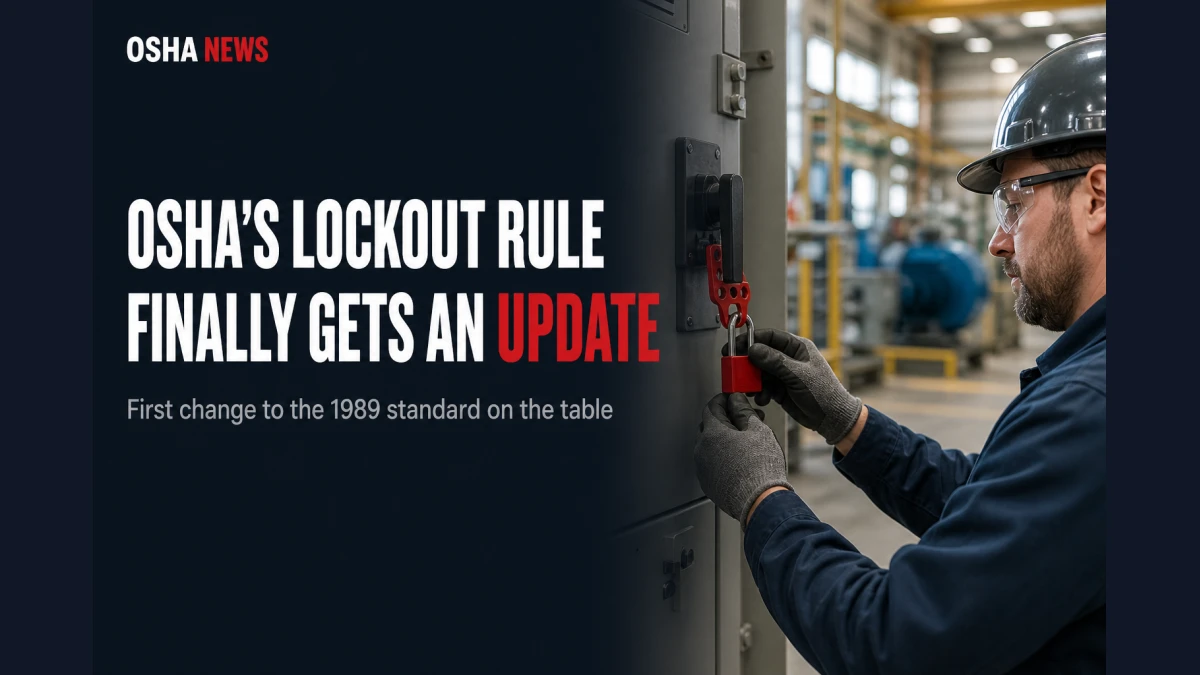
OSHA is targeting November 2026 to publish a proposed rule updating 29 CFR 1910.147, the Control of Hazardous Energy standard, better known as lockout/tagout. If it happens on schedule, it would be the first substantive change to the standard since OSHA wrote it in 1989.
A Standard Written for 1989's Machines
Lockout/tagout exists to make sure a machine cannot restart while someone is servicing it. The 1989 version of the rule assumes that protection comes from physical devices: breakers, valves, padlocks, tags. Its definition of an energy-isolating device (EID), the hardware a worker locks out, explicitly excludes push buttons, selector switches, and other control-circuit-type devices.
That exclusion made sense when hazardous energy was almost always controlled mechanically. It doesn't account for how much modern equipment, programmable logic controllers, safety-rated automation, robotics, light curtains, safety laser scanners, and trapped-key interlocks, now controls energy through circuits and software rather than a physical disconnect alone.
What the Update Would Actually Add
According to the Department of Labor's own regulatory agenda, reported on by Safety+Health Magazine and industrial-safety trade outlet 3E, the proposed rule would extend recognition to computer-based and remote-switch hazardous-energy controls, bringing the standard closer to how consensus standards like ANSI/ASSP Z244.1 already treat modern control systems. The agenda lists this as a proposed rule stage, meaning a notice of proposed rulemaking (NPRM) and a public comment period, not a final rule. Nothing changes for employers unless and until a final rule is published, which would still be a separate step after comments close.
Why This Particular Standard
Lockout/tagout isn't a minor rule getting a technical cleanup. It's one of OSHA's most heavily enforced standards every year. In our own coverage of OSHA's FY2026 Top 10 Most Cited Standards, lockout/tagout ranked third, 1,863 citations in preliminary FY2026 data, up from fourth place the year before even as its raw citation count fell 14.4%.
In our full historical enforcement database, 1910.147 carries 244,344 citations and $350,347,553 in total penalties, including 1,713 Willful citations worth $49,397,430. That's a standard employers are still getting wrong at scale, decades after it was written. We've covered what that looks like on the ground: a Tyson Fresh Meats worker who died when a pallet machine activated during a repair he believed was locked out, and a New Jersey car wash cited for the identical lockout/tagout failure at four separate locations. For how the procedure is supposed to work when it's followed correctly, see our explainer on OSHA's real 8-step lockout/tagout procedure.
What Happens Next
A proposed rule is not a final rule. If OSHA publishes the NPRM on schedule, the next steps are a public comment period, review of those comments, and then a decision on whether and how to finalize the change, a process that can take months to years. We'll update our coverage once the actual text of the proposal is public.