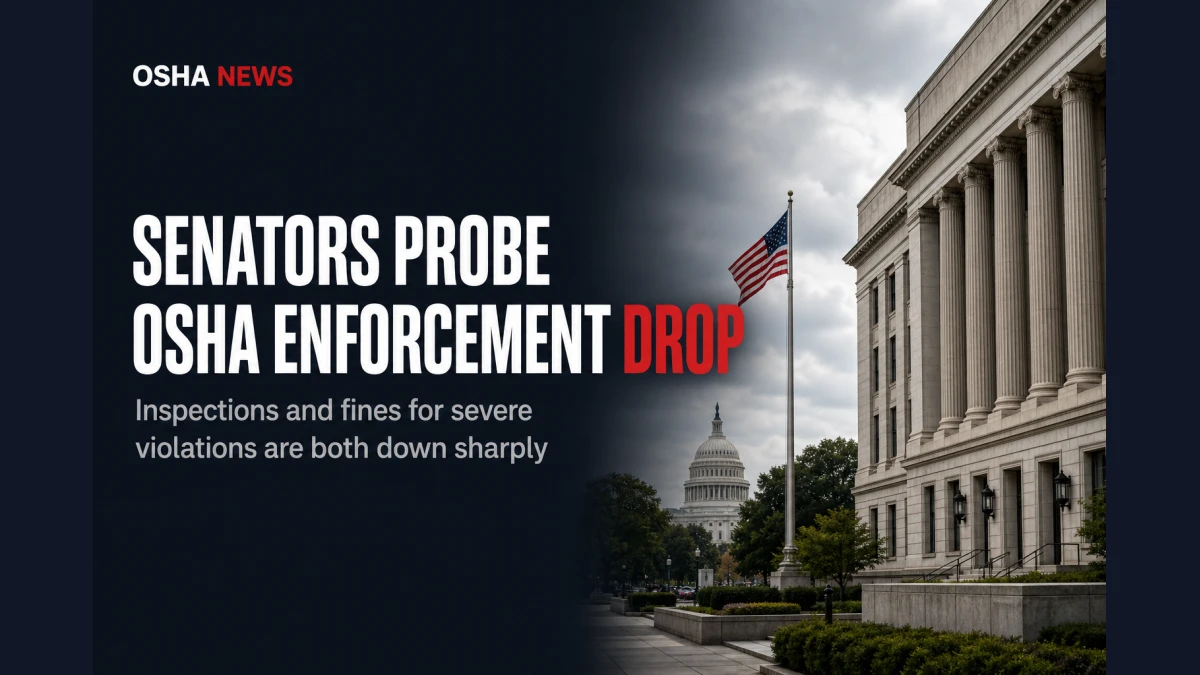
Six U.S. senators say the numbers are clear: fewer OSHA inspections, fewer citations, and lower penalties than at any point in recent memory. OSHA and the Department of Labor haven't disputed the underlying data. What's contested is why it's happening, and what it means.
What the Senators Found
On February 19, 2026, Senators Elizabeth Warren, Angela Alsobrooks, Tammy Baldwin, Richard Blumenthal, Alex Padilla, and Ron Wyden sent a letter to the Department of Labor and OSHA launching an investigation into a documented decline in enforcement activity. According to their letter, OSHA conducted 20 percent fewer inspections in 2025 and issued 42 percent fewer fines for severe workplace violations that year. A separate analysis the senators cited found 35 percent fewer cases brought during the first nine months of the current administration, with penalties imposed averaging 47 percent lower than the comparable period across the prior 17 years.
"If employers know that they are unlikely to face hefty fines, they may be less likely to adhere to safety standards that keep American workers safe," the senators wrote. They requested specific information from OSHA by March 4, 2026, including whether the agency had directed inspectors to reduce the number of inspections, citations, or specific violations cited.
The Administration's Stated Approach
Separately, OSHA under the current administration has expanded penalty reductions available to smaller employers and prioritized compliance assistance initiatives, including an expanded opinion letter program that lets employers request OSHA's position on a specific compliance question in writing. Workplace safety attorneys tracking the agency describe this as a deliberate shift toward voluntary compliance tools rather than a wholesale retreat from enforcement, noting that unannounced inspections are still expected to continue in 2026.
Those two things, a documented decline in inspections and penalties, and a stated agency preference for compliance assistance over citation volume, are being described very differently depending on who's doing the describing. The senators frame the decline as a risk to worker safety. The administration's own compliance-assistance programs are framed as support for employers trying to get it right rather than a reduction in what employers who don't are exposed to.
Why This Matters Beyond the Politics
Whatever the cause, inspection and penalty volume are the two levers that actually generate the enforcement data this entire site is built on. A National Emphasis Program, a Repeat citation, a Willful classification, all of it depends on OSHA actually showing up and writing citations. If 2025's reduced inspection volume is the new baseline rather than a one-year dip, it changes what the next few years of real enforcement data, the kind this site reports on case by case, actually looks like.
OSHA's recordkeeping and inspection rules govern how an inspection gets opened and a citation gets classified in the first place, the mechanics that sit underneath whatever volume of enforcement actually happens in a given year.