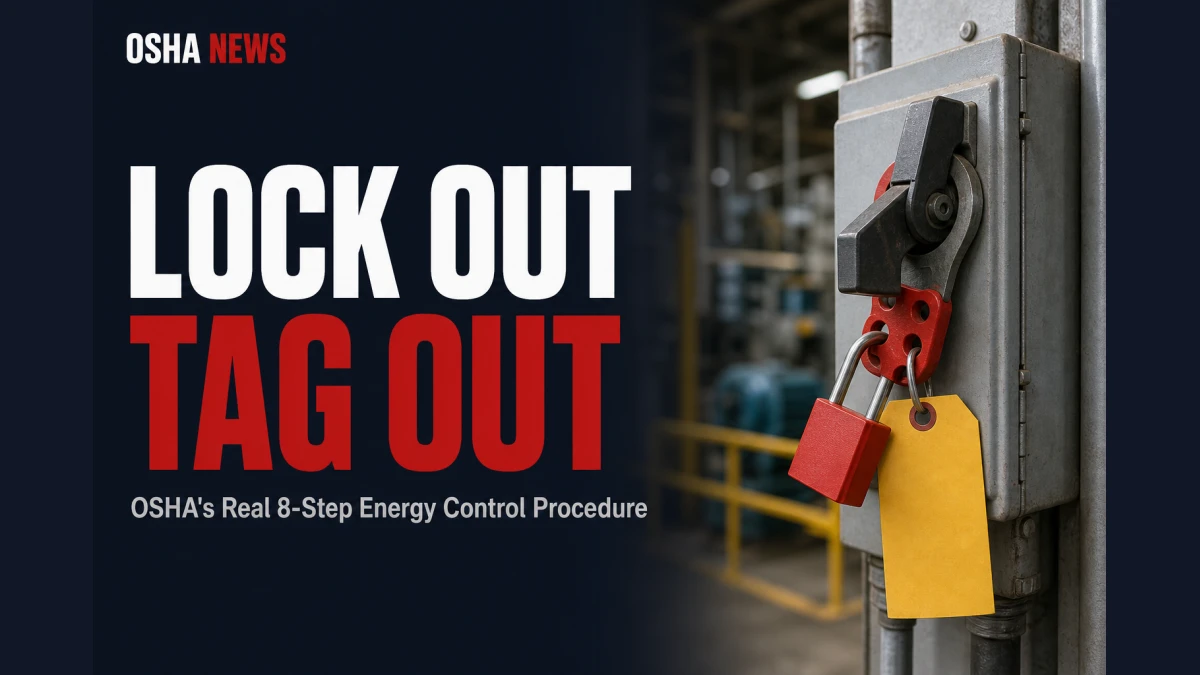
Lock out tag out, OSHA's term for it is the energy control procedure in 29 CFR 1910.147, means physically isolating a machine from every energy source that could move, start, or shock it, then locking that isolation in place with a device only the worker who applied it can remove. It exists because a machine someone thinks is off can still kill the person servicing it, from stored hydraulic pressure, a spring under tension, or someone else flipping a switch they didn't know was live.
In our own enforcement database, 1910.147 isn't just one of the standards we cover. It's the biggest: 244,344 citations and $350,347,553 in total penalties, more than any other single standard in our records, including hazard communication and fall protection. The single largest share of that, over $38 million across more than 40,000 citations, comes from 1910.147(c)(1) alone: an employer with no written energy control program at all. The second largest, over $80 million combined, comes from 1910.147(c)(4), the requirement that lockout devices actually be applied, not just planned for.
What Does "Lockout" vs. "Tagout" Actually Mean?
A lockout device physically prevents a machine from being operated. Think of an actual padlock on a circuit breaker, a valve, or a disconnect switch. Nobody can turn it back on without the key, and only the worker who applied the lock has that key.
A tagout device is a warning tag attached to the same point, telling anyone who finds it not to operate the equipment. It doesn't physically stop anything. A tag can be read and ignored, cut off, or missed entirely by someone who doesn't look closely.
OSHA's standard treats these as genuinely different levels of protection, not interchangeable labels for the same idea. 1910.147 requires lockout whenever the equipment has a lockout capability at all. Tagout alone is only acceptable on equipment that was never designed to accept a lock, and even then, the employer has to prove the tagout program gives workers protection "equivalent" to a lockout, which in practice means added training, more frequent inspections, and often a second isolation method layered on top.
What Has to Be on a Lockout/Tagout Tag?
Our research turned up a real, recurring question nobody answers precisely: what does a tag actually have to say? Under 1910.147, a tagout device has to carry a legend, something like "Do Not Start," "Do Not Open," "Do Not Operate," or "Do Not Energize," warning against the specific hazard if the machine were energized. It also has to be durable enough to survive the actual environment it's used in (weather, moisture, corrosive atmospheres) and substantial enough that it can't come off by accident, no paper luggage tags held on with string. A tag that falls off, fades illegibly, or just says "caution" with no instruction doesn't meet the standard.
The Real Step Sequence, and Why Sources Disagree
We checked OSHA's own Appendix A to 1910.147, the "Typical Minimal Lockout Procedure," directly, because a lot of safety-training content online describes a 5-step process, other content describes 7, and neither number actually matches what the appendix itself lists. Appendix A lays out eight numbered elements:
1. Notify all affected employees that the machine is being shut down and locked out. 2. Identify the type and magnitude of the energy the machine uses, and know how to control it, before touching anything. 3. Shut the machine down using its normal stopping procedure. 4. Deactivate the energy isolating device so the machine is actually isolated from its energy source. 5. Lock out the isolating device with an individually assigned lock. 6. Relieve or restrain any stored or residual energy, capacitors, springs, elevated parts, flywheels, or pressurized air, gas, steam, or water, that could still move the machine. 7. Verify the isolation actually worked: confirm no one is exposed, then try the machine's own start controls to prove it won't run. 8. Only once all of that is done is the machine considered locked out.
The 5-step and 7-step versions floating around most training content aren't wrong exactly, they're just compressing OSHA's eight elements differently: some merge notification into the shutdown step, some drop "the machine is now locked out" since it's a status statement rather than an action, and most treat energy identification (step 2) as something done ahead of time rather than counted as its own step in the moment. The actual, correctly sourced sequence has eight distinct elements, and the two most commonly skipped by employers we've seen cited are 6 (relieving stored energy) and 7 (verifying isolation before work starts), because both require a worker to confirm something is actually true rather than just assume the earlier steps worked.
Authorized Employee vs. Affected Employee
These two terms get blurred constantly, but 1910.147 defines them as genuinely different roles with different rights and duties.
An authorized employee is the person who actually performs the lockout, applies their own lock, and is the only person permitted to remove it. They're trained on the specific energy control procedure for that machine, not just lockout/tagout in general.
An affected employee is anyone else whose job requires them to work in an area where that lockout is in effect, or whose job is on the machine being serviced, but who isn't the one applying the lock. They have to be notified before the lockout happens and again before it's removed, but they don't touch the lock itself.
The distinction matters because the standard's training requirements differ for each: an authorized employee needs to understand the actual energy sources and hazardous energy control methods for that specific equipment, while an affected employee's training only has to cover recognizing when a lockout is in place and not attempting to restart locked-out equipment.
When More Than One Person Is Working on the Same Machine
A single lock and a single key don't work when four people need to service the same equipment at the same time. 1910.147(f)(3) covers group lockout specifically: one authorized employee, usually the shift supervisor or a designated lead, takes primary responsibility, but the standard still requires that every individual authorized employee be able to apply their own personal lock to the group lockout device, usually a lock box or a multi-hasp, so that the machine can't be reenergized until every single person has removed their own lock. No one person's "all clear" authorizes restarting the machine for anyone else.
A Real Case Where This Exact Standard Failed
A Wisconsin mechanic cut into a sealed 55-gallon drum with a plasma cutter, not knowing it held flammable liquid, and died from the explosion eight days later. That case is built around a hazard communication failure, but the same OSHA inspection also found three separate 1910.147 violations at the same shop, unrelated to the drum itself, found simply because inspectors were already on site looking at how the shop handled hazardous energy on its other equipment. It's a useful reminder that lockout/tagout gaps often surface as a secondary finding, not because an inspector went looking for them specifically, but because once one safety program is found broken, the rest of the shop's programs get checked too.
Why This Standard Carries the Heaviest Enforcement Weight on Record
Fall protection and hazard communication both post higher annual citation counts in OSHA's current top-10 list, because they apply to a broader range of everyday work. But 1910.147 has accumulated more total citations and more total dollars in our own full historical database than any other standard we track, largely because it covers every machine in every industry that has ever needed to be serviced, repaired, or cleaned, forever, not just construction sites or one hazard category. A written program alone, done honestly, resolves the single largest category of citation under this standard. The employers who get this wrong are overwhelmingly the ones who never wrote the energy control program down in the first place, not the ones who wrote one and executed it imperfectly.