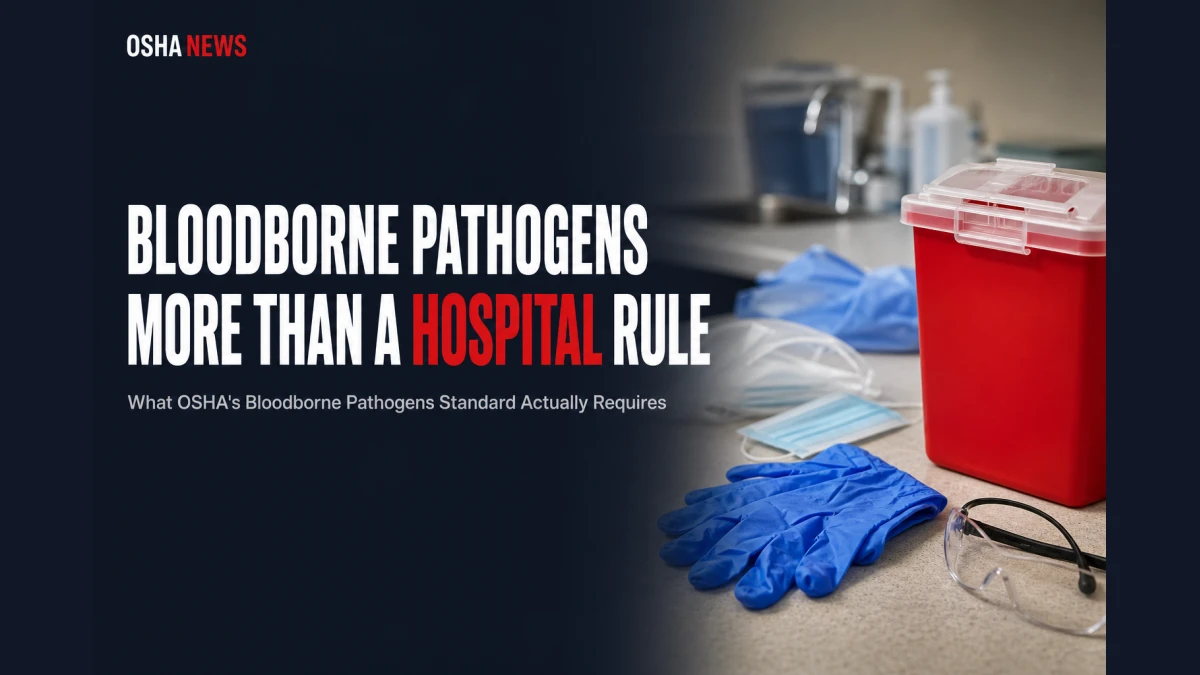
What OSHA's Bloodborne Pathogens Standard Actually Requires
OSHA's bloodborne pathogens standard, 29 CFR 1910.1030, requires any employer with workers who have a reasonably anticipated risk of contact with blood or other potentially infectious materials to maintain a written exposure control plan, make hepatitis B vaccination available at no cost within 10 days of initial assignment, train workers at hire and at least annually after that, and follow a defined set of universal precautions on every job, every time, regardless of whether a specific patient, room, or container looks like a risk. Nationwide, OSHA has issued 102,470 citations under this standard, totaling $48,210,711.24 in penalties. Getting it wrong isn't a paperwork problem. It's the difference between a worker who's protected before an exposure happens and one who finds out what was in a container only after it's already in a wound.
Who Does This Standard Actually Cover?
The standard doesn't say "hospitals." It says any employee with occupational exposure, meaning reasonably anticipated contact with blood, semen, vaginal secretions, or other potentially infectious materials through the skin, eye, mouth, or an open wound. That includes the obvious jobs: nurses, phlebotomists, EMTs, dental staff, medical waste haulers. It also includes a much longer list most employers don't think about until it's too late: housekeeping staff who change linens and empty trash in hotel rooms, janitorial crews, tattoo and body piercing studios, funeral home workers, correctional officers, laundry workers handling soiled linens, and research lab staff.
One of the clearest recent examples of that second group is a Marriott International, Inc. property in Chandler, Arizona. OSHA cited the company two citations totaling $30,000 after an inspection found gaps tied to the standard's post-exposure evaluation and training requirements, with 13 employees listed as exposed. Neither citation was contested, and both became a final order on June 18, 2025. A hotel is not the industry most people picture when they hear "bloodborne pathogens standard," and that's exactly the point: if housekeeping staff can be exposed to a needle left in a wastebasket or blood on linens, the standard applies to that employer the same way it applies to a hospital.
What Is an Exposure Control Plan?
An exposure control plan is the written document the standard requires every covered employer to have, identifying which job classifications and tasks involve occupational exposure, and spelling out exactly how the employer will eliminate or minimize it through engineering controls, work practices, and personal protective equipment. It isn't a one-time document. The standard requires it to be reviewed and updated at least annually, and sooner if new positions, tasks, or exposure-related technology (like a different type of sharps container) change what the plan needs to cover. A plan that was accurate in 2022 and hasn't been touched since is, by the letter of the standard, already out of compliance.
What Is the Hepatitis B Vaccination Requirement?
Employers must make the hepatitis B vaccine available, at no cost, to every employee with occupational exposure, and the first dose has to be offered within 10 days of that employee's initial assignment to exposure-related duties. This isn't a benefit an employer can choose to skip offering. If a worker declines, the standard requires a signed declination form on file, and the employer still has to make the vaccine available later if the employee changes their mind. The 10-day window exists because hepatitis B's incubation period means waiting until after a first possible exposure is too late for the vaccine to do its job the way it's designed to.
What Are Universal Precautions?
Universal precautions is the specific term the standard uses for treating all human blood and certain body fluids as if they are infectious for HIV, hepatitis B, and other bloodborne pathogens, every time, without trying to judge in the moment which specific situations are actually dangerous. The reasoning is deliberately conservative: a worker can't reliably tell by looking whether a given spill, needle, or soiled item carries a pathogen, so the standard removes that judgment call entirely and requires the same protective response regardless. In practice that means gloves before contact, not after a visible sign of blood; a sharps container that's never overfilled or improvised; and no eating, drinking, or touching your face in an area where exposure is possible.
Training, Sharps Injury Logs, and Engineering Controls
Training has to happen at initial assignment to exposure-related tasks and at least annually after that, covering the actual signs and symptoms of bloodborne diseases, the specifics of the employer's own exposure control plan, how to recognize tasks that involve exposure, and exactly what to do if an exposure incident happens, including who to report it to and what post-exposure evaluation is available. Training records have to be kept for three years from the date the training occurred, not from the date of hire.
Employers using needles or other sharps also have to maintain a sharps injury log, documenting the type and brand of device involved in each injury, the location, and a description of the incident, and they're required to review and update the list of safer medical devices available at least annually, reflecting changes in technology. A written exposure control plan that still lists only the sharps devices from five years ago, with nothing newer evaluated, is itself a sign the standard isn't being followed as written.
Why This Standard Exists
Every piece of this standard, the 10-day vaccination window, the annual plan review, universal precautions applied without exception, traces back to the same basic fact: a bloodborne pathogen doesn't announce itself. A linen that looks clean can carry it. A sharps container that looks full enough can still cause an injury during handling. The standard exists because the alternative, relying on a worker's in-the-moment judgment about which situations are actually dangerous, has already been tried, and it's what the standard was built to replace. OSHA's hazard communication standard works on the same underlying logic in a different hazard category: the information a worker needs has to reach them before the exposure, not after.