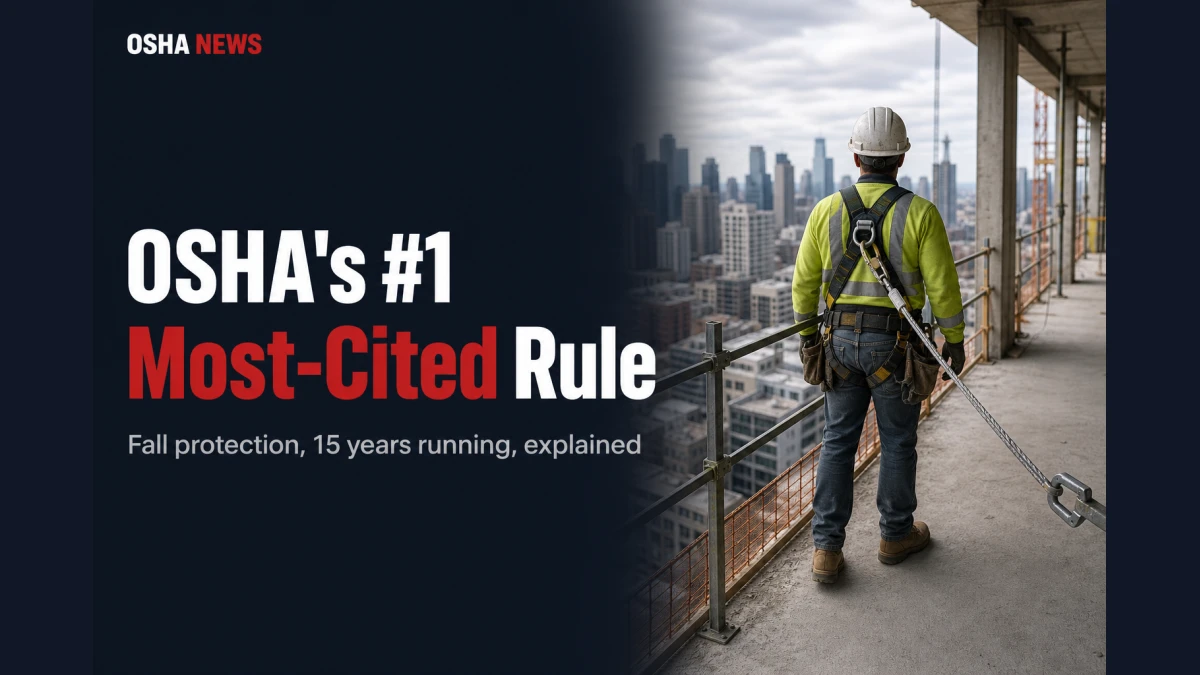
Fall protection, 29 CFR 1926.501, has been OSHA's single most-cited standard in the entire country for 15 consecutive fiscal years. Not the most-cited construction standard. The most-cited standard, period, ahead of every general industry rule too. In our own database of more than 13 million violations, the four sections that make up Subpart M, 1926.500 through 1926.503, carry 598,355 citations and nearly $851 million in total penalties. This is what that standard actually requires, and three real cases showing exactly what happens when it isn't followed.
Subpart M Is Four Sections Working as One System
Fall protection in construction isn't one rule. It's four sections of 29 CFR 1926 Subpart M that only make sense together. 1926.500 sets the scope and defines the terms everything else depends on, what counts as a "lower level," what a "guardrail system" actually is, what "unprotected sides and edges" means. 1926.501 is the actual duty: when and where an employer must provide fall protection at all. 1926.502 is the engineering criteria, the specific, measurable standards each type of protection system (guardrails, safety nets, personal fall arrest systems) has to meet to count as real protection rather than a good-faith gesture. 1926.503 is training: making sure the people exposed to the hazard actually understand it.
Treat any one of these four in isolation and the standard stops making sense. A guardrail that exists but doesn't meet 1926.502's engineering criteria doesn't satisfy 1926.501's duty to provide protection. A worker trained once, years ago, on equipment the company no longer uses doesn't satisfy 1926.503 either. The real failures OSHA finds almost always trace back to one section quietly failing while another looks fine on paper.
Why Six Feet
Under 1926.501, fall protection in construction is generally required at six feet above a lower level, lower for a few specific, higher-risk tasks the standard calls out separately. That six-foot line isn't arbitrary. It's the construction-specific trigger height written into this exact subpart, distinct from general industry's own fall protection rule under a different part of 29 CFR entirely, since a general industry workplace and a construction site present fundamentally different fall exposure patterns. Our construction regulations guide covers how this trigger height sits alongside the rest of 1926's structure, including the subparts with their own different heights, like steel erection.
When the Guardrail Itself Was the Failure
A real-world illustration of 1926.502's engineering criteria: at a high-rise jobsite in Hoboken, New Jersey, a company called Highrise Safety Systems, Inc. installed a guardrail at the edge of the 8th floor. It was there. It just couldn't do its job: it failed to withstand the 200 pounds of force 1926.502 requires a guardrail to withstand, which would have exposed anyone who fell or leaned against it to a fall of roughly 80 feet. A separate lifeline on the same site had been damaged by nails driven through it by a different contractor's crew. Four citations, $44,685 in penalties, none contested. A guardrail that's present but doesn't meet the engineering spec isn't a lesser version of compliance. It's the same as no guardrail at all the moment someone actually leans on it.
When the Training Gap Was the Repeat
CS Contractor Corp shows what 1926.503 failing looks like in practice, and what a Repeat classification actually means. Framing crews were working roughly 12 feet up at a Magnolia, Delaware jobsite without the fall protection retraining required once a gap in an employee's understanding becomes apparent, the exact kind of circumstance 1926.503 is built around: the standard doesn't require retraining on a fixed annual schedule, it requires it when the employer has reason to believe an employee's understanding or skill has lapsed, or when the equipment or worksite conditions have changed enough to make earlier training obsolete. Three of the four citations here were classified Repeat, traced to an identical citation for the same standard at a different jobsite in Philadelphia the year before, carrying a combined penalty of $58,729. A Repeat classification exists specifically to cost more the second time a company is told about the same gap.
When Protection Wasn't Provided at All
Empire Monsters Inc. is the most direct kind of 1926.501 failure: a roofing crew in Dover, New Hampshire with no fall protection provided on part of the job at all, not a deficient system, an absent one. Thirteen citations followed, ten Serious, one Repeat, two Other-Than-Serious, totaling $59,781. The Repeat citation here carried no identifiable prior case under the exact same company name in the public data, a real, disclosed gap rather than a guessed-at explanation, the kind of honest uncertainty that's part of reading real enforcement records rather than a clean textbook example.
What Fall Protection Training Actually Requires
1926.503 requires an employer to train every employee exposed to a fall hazard to recognize that hazard and understand the procedures that minimize it, including the correct use of whatever protection system is actually in place, before that employee is exposed to it. There is no fixed annual or periodic retraining schedule written into the standard. Retraining becomes mandatory specifically when the employer has reason to believe an employee no longer has the required understanding or skill, when the workplace itself changes enough to make earlier training obsolete, or when the type of fall protection system or equipment in use changes. In our own data, 1926.503 alone carries 96,126 citations and $72.78 million in penalties, evidence that the training requirement is cited on its own, separately from the equipment and engineering failures, not just as an afterthought attached to a bigger violation.
The Real Enforcement Numbers
Across the four sections of Subpart M in our database: 1926.500 carries 138,347 citations ($31.86 million), 1926.501 carries 312,076 citations and $698.04 million, the largest total penalty figure of any single standard in our entire dataset, 1926.502 carries 51,806 citations ($48.04 million), and 1926.503 carries 96,126 citations ($72.78 million). Within 1926.501 specifically, the classification breakdown shows what actually drives the cost: 260,301 Serious citations averaging $1,589.55 each, 26,444 Repeat citations averaging $7,457.80, and 3,289 Willful citations averaging $32,212.69, more than twenty times a single Serious citation. The jump from Serious to Willful isn't incremental. It's the clearest signal in the data of which failures OSHA's own investigators concluded were not accidents.
Two companion pieces cover the equipment side of this standard in depth: OSHA guardrail requirements, the passive system that prevents a fall before it starts, and personal fall arrest systems, the active system that catches a worker already falling.