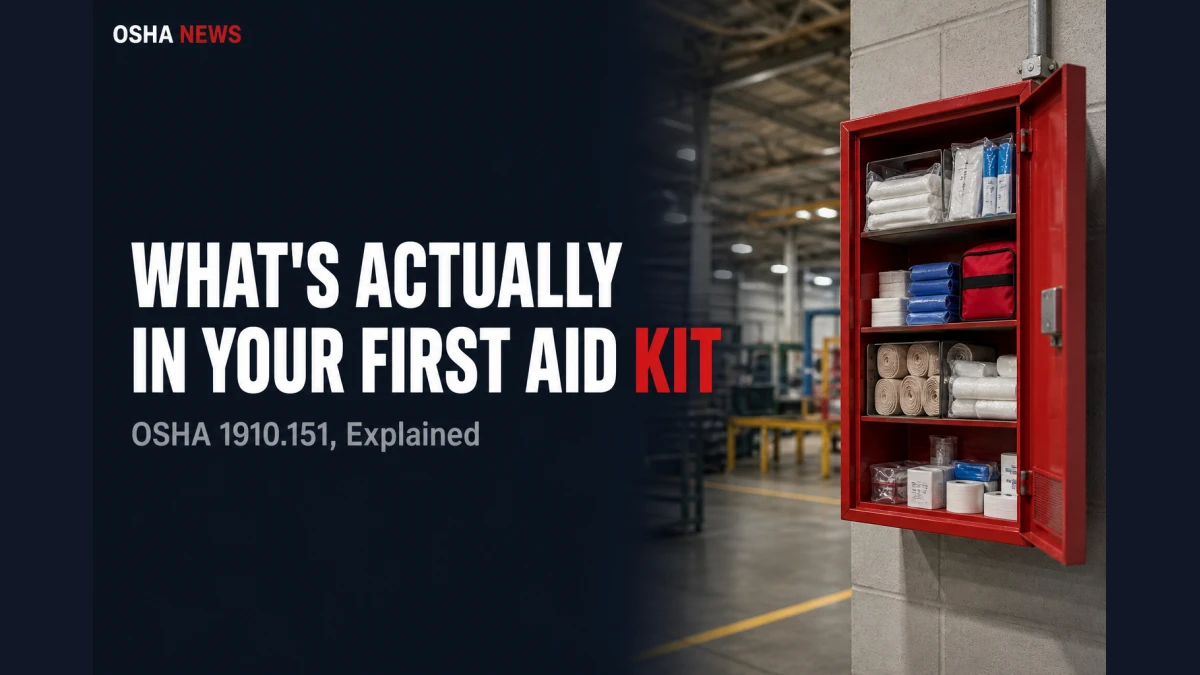
OSHA's own first aid standard, 29 CFR 1910.151, does not list a single required item. It requires "adequate first aid supplies" be "readily available," and nothing more specific than that in the regulatory text itself. The actual contents list employers are expected to follow comes from a separate, voluntary consensus standard the regulation references in its appendix: ANSI/ISEA Z308.1. In our own enforcement database, this standard carries 104,910 citations and $47.5 million in penalties, and the single biggest driver of that total isn't a missing bandage, it's missing eyewash and quick-drench equipment for corrosive exposure, a different subsection of the same rule entirely.
What 1910.151 Actually Says
The operative text is short: "In the absence of an infirmary, clinic, or hospital in near proximity to the workplace which is used for the treatment of all injured employees, a person or persons shall be adequately trained to render first aid. Adequate first aid supplies shall be readily available." That's subsection (b), and it's the entire first aid supplies requirement. There's no item list, no required quantity, no reference to a specific kit class, inside the rule itself.
OSHA fills that gap through a non-mandatory appendix, Appendix A to 1910.151, which points employers toward ANSI/ISEA Z308.1, Minimum Requirements for Workplace First-Aid Kits. A kit that meets the current ANSI standard is treated as meeting the "adequate supplies" bar. A kit that doesn't isn't automatically a violation, but it leaves an employer defending a judgment call instead of pointing to a recognized standard, and OSHA's own guidance leans on Z308.1 heavily enough that most compliance officers do too.
How "Near Proximity" Became a Stopwatch
The phrase "near proximity" sounds vague because it is, deliberately, since what counts as near depends entirely on how fast real medical help can actually get there. OSHA has interpreted it for decades through its own letters of interpretation as meaning emergency care has to be reachable within roughly three to four minutes of the workplace. That window isn't arbitrary. It tracks the point past which an injury involving stopped breathing, cardiac arrest, or uncontrolled bleeding starts causing permanent harm rather than being something first aid can still fully reverse.
Practically, that three-to-four-minute test is what actually decides whether a workplace needs a trained first aid responder on site at all. A corporate office two minutes from a hospital ER may not need one. A warehouse, a remote jobsite, or a rural facility twenty minutes from the nearest clinic almost certainly does, and "adequately trained to render first aid" in 1910.151(b) is the duty that kicks in once that distance test is failed.
Class A and Class B Kits Are Not the Same Kit
ANSI Z308.1 splits workplace first aid kits into two classes, and the difference isn't cosmetic. A Class A kit is built for the kind of injuries common in a low-risk environment, an office, a retail floor, light assembly work. A Class B kit is built for a workplace where more severe injuries are a real possibility, higher-hazard manufacturing, construction, anywhere heavy equipment or higher energy levels are part of the job.
The quantities tell the real story. A Class A kit's minimum fill includes 16 adhesive bandages (1 by 3 inches) and 10 antibiotic applications. A Class B kit requires 50 adhesive bandages and 25 antibiotic applications, roughly triple the Class A minimum across most items, plus two items Class A doesn't require at all: a splint and a tourniquet. A workplace that defaults to the cheaper Class A kit because nobody checked which class actually fits the job is choosing a kit sized for a paper cut, in a building where the real exposure is a laceration or a crush injury.
The Citation Nobody Expects: Eyewash, Not Bandages
Ask most safety managers what gets cited under the first aid standard and they'll guess missing kit items. The real data says otherwise. Of the 104,910 citations in our database under this standard, 82,610, nearly 80 percent, fall under 1910.151(c), the requirement for suitable facilities to quickly drench or flush the eyes and body where corrosive materials could injure an employee. That's $42.4 million of the standard's $47.5 million in total penalties, concentrated in a provision that has nothing to do with bandages or kit classes at all. The supplies-and-training subsection, 1910.151(b), the one this whole piece has been describing, carries 21,027 citations and $4.6 million, roughly a tenth of the eyewash total.
OSHA's general industry standards, Subpart K, group the first aid rule alongside the broader medical services framework it sits inside, and the eyewash-station gap is worth knowing specifically because it means a workplace handling any corrosive chemical needs to check 1910.151(c) separately from whatever first aid kit sits on the wall.
What Escalation Actually Looks Like: One Company, Fifty Years, One Standard
United Parcel Service has been cited under 1910.151(b) more than once a year, on average, going back to 1972. The earliest citation on record, at a Manchester, New Hampshire facility, carried a $25 penalty. By 1993, a Florence, South Carolina citation under the identical subsection carried no contested challenge and resolved within about fourteen months. By 2021, a Waco, Texas citation under the same subsection had grown to $14,502. In August 2023, a McKinney, Texas facility was cited again, this time $62,104.70. And in August 2024, within two weeks of each other, UPS facilities in Killeen, Texas and McKinney, Texas were each cited $165,514, both classified Repeat, both for 1910.151(b).
That's not inflation. It's what a Repeat classification actually does to a penalty once a company has already been told about a gap in exactly the same provision before. A first citation under this subsection is routinely a few hundred dollars. A Repeat citation, found again at the same or a related facility, can run into six figures for the exact same underlying failure, first aid supplies and training that weren't where OSHA expected to find them.
What Employers Actually Need to Do
Three steps cover what 1910.151 actually requires, separate from what a safety-supply catalog will try to upsell: confirm whether your nearest emergency medical care genuinely falls inside that three-to-four-minute window, because that answer decides whether on-site trained responders are legally necessary, not just a nice-to-have; match the kit class, A or B, to the real injury risk of the work being done, not the cheaper default; and if any process on site involves a corrosive substance, check 1910.151(c)'s eyewash and drench requirement as its own, separate obligation, since our own enforcement data shows that's where the real penalty exposure sits.
OSHA's hazard communication standard is the other half of knowing what you're exposed to in the first place, since a safety data sheet is often what tells a worker a substance is corrosive before the eyewash requirement ever becomes relevant.