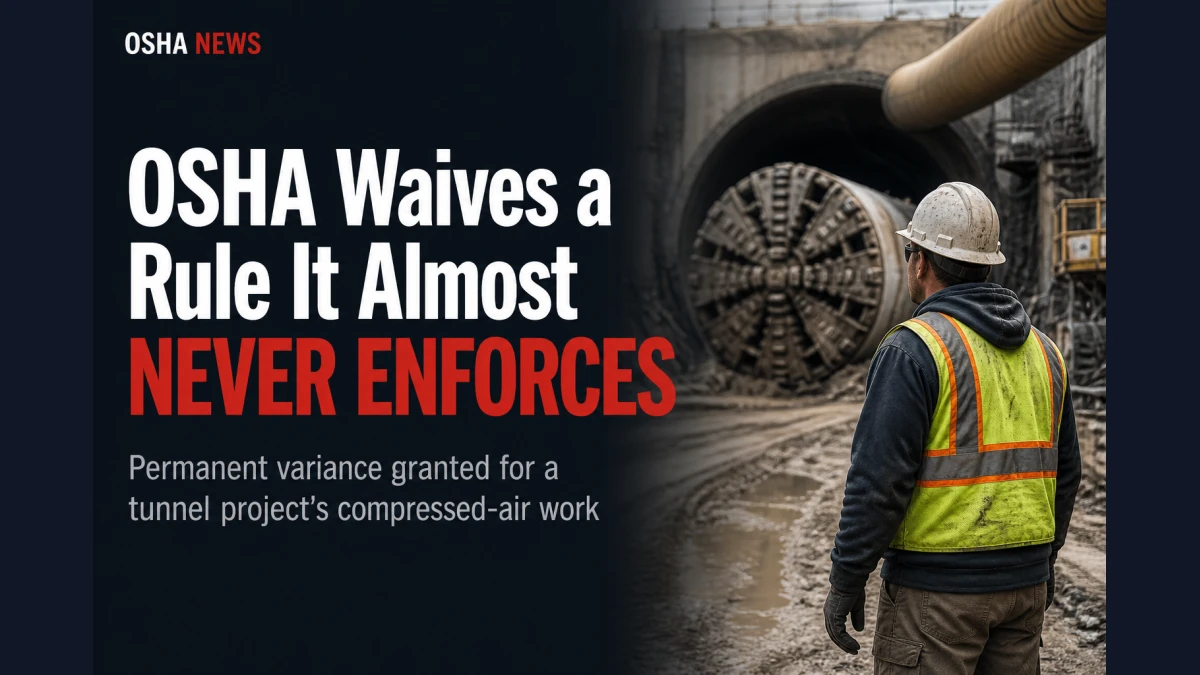
OSHA has granted a permanent variance to Obayashi-Jay Dee Joint Venture (OJD), the contractor building the Cemetery Brook Drain Tunnel Project in Manchester, New Hampshire, allowing the company to depart from two specific provisions of the agency's compressed-air construction standard. The variance took effect October 29, 2026, letting OJD use modern tunnel-boring equipment and updated hyperbaric medical protocols instead of the decompression tables and automated-control hardware the standard otherwise requires.
What the Variance Actually Changes
The compressed-air standard for construction, 29 CFR 1926.803, requires employers to decompress workers using tables published in the standard's own Appendix A, and to use automated operational controls and a dedicated decompression chamber during certain hyperbaric work. OJD's variance covers two of those requirements specifically: the decompression-table requirement at 1926.803(f)(1), and the automated-controls requirements at 1926.803(g)(1)(iii) and (xvii). One thing the variance does not touch is the standard's maximum pressure limit at 1926.803(e)(5). OJD's own Hyperbaric Operations Manual caps worker exposure at 37 pounds per square inch gauge, within that existing limit, so no pressure-limit relief was requested or granted.
The Technology Behind the Request
OJD builds the tunnel using an earth-pressure-balanced tunnel boring machine, a method that pressurizes only the machine's forward working chamber rather than the entire tunnel, limiting both how many workers are exposed to compressed air and how long. Workers only enter that pressurized chamber for periodic interventions, inspecting or replacing the cutting tools on the machine's cutter head, moving through a double-compartment airlock designed for a maximum crew of three. According to OJD's application, its decompression protocols incorporate supplemental oxygen in a way the standard's decades-old tables don't account for, and the company argued those updated protocols protect workers at least as well as strict compliance with the tables would.
A Standard Our Data Shows Is Rarely Enforced
Based on OSHA News' own enforcement database, 29 CFR 1926.803 is one of the least-cited construction standards we track. Nationwide, it has drawn just 16 citations since 1974, totaling $3,902.50 in combined penalties, and not one since 2005, when OSHA cited Hayward Baker, Inc. in St. Thomas, U.S. Virgin Islands. A single 1992 inspection of Kiewit-Shea AJV in Baltimore, Maryland accounts for four of those 16 citations, including the only one in our data that falls under the standard's broader (g) subsection governing decompression chambers and controls, cited there under paragraph (g)(1)(v), a different specific provision than the (g)(1)(iii) and (xvii) paragraphs OJD's variance applies to. Neither of the exact provisions OJD is now exempt from, (f)(1) or (g)(1)(iii)/(xvii), has ever drawn a citation in the data we track.
How a Permanent Variance Actually Works
A Section 6(d) permanent variance lets an employer depart from a specific OSHA standard on the record, not by informal waiver. OJD applied in June 2025, and OSHA published OJD's proposed determination for public comment in May 2026, granting an interim order so work could continue while the request was under review. OSHA received no comments disputing its preliminary finding and no objections to granting the variance, and the agency formally granted the permanent variance in October 2026. The grant applies only to the Cemetery Brook Drain Tunnel Project, not to any other OJD project, current or future.