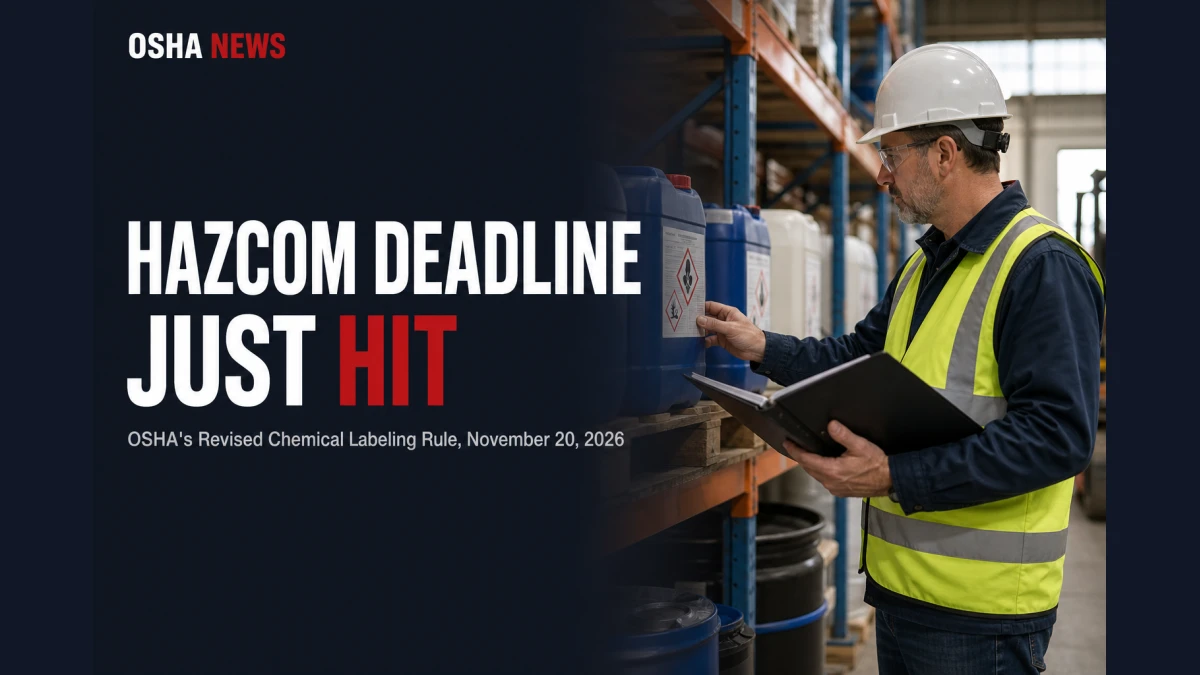
The compliance deadline attached to OSHA's 2024 revision of the Hazard Communication Standard arrived on November 20, 2026. Covered employers were required to have workplace chemical labels, written hazard communication programs, and employee training updated to address any newly identified hazardous substances under the revised standard, four months later than OSHA's original schedule called for.
What the November 20 Deadline Actually Required
OSHA's Hazard Communication Standard, 29 CFR 1910.1200, requires employers to run a hazard communication program built on three pieces working together: a written plan describing how the workplace handles chemical hazards, labels and other warnings on containers, and employee training. The November 20 deadline covered the substance side of OSHA's 2024 update specifically, employers had to fold any newly classified hazardous substances into their existing written program, update container labeling where those substances appear, and train employees on any new hazard information. The rule does not require employers to start over. It requires the existing three-part structure to reflect the revised hazard classifications OSHA adopted in 2024.
Why the Deadline Moved From July to November
This date was not OSHA's original target. The agency's 2024 final rule set a July 20, 2026 compliance date for employers on substances. On January 15, 2026, OSHA published a final rule in the Federal Register extending that date, and three related dates, by four months each. OSHA's stated reason was straightforward: the agency had not finished the compliance guidance materials it intended employers to use, and said it needed the extra time so "the regulated community and OSHA personnel" could actually benefit from that guidance before the date became mandatory. The same extension pushed the manufacturer and importer deadline for chemical mixtures from July 19, 2027 to November 19, 2027, and the employer deadline for mixtures from January 19, 2028 to May 19, 2028.
What OSHA's Own Enforcement Data Shows
The requirement this deadline updates, a written hazard communication program under 29 CFR 1910.1200(e)(1), is already the single most cited piece of the entire standard. In our enforcement database, that one subsection carries 246,035 citations and $73,327,524 in penalties, more than citations for initial employee training under 1910.1200(h)(1) (76,239 citations, $21,625,304) and safety data sheet access under 1910.1200(g)(1) (74,442 citations, $6,883,772) combined. The pattern makes sense operationally: an inspector can confirm a written program exists, or does not, faster than evaluating whether training content or an SDS is technically complete. We've also covered what a hazard communication failure looks like outside a citation count, including a Wisconsin mechanic killed after cutting into a sealed drum he had no way of knowing held flammable liquid.
What's Still Coming
November 20 was not the last hazcom deadline on OSHA's calendar. Chemical manufacturers, importers, and distributors have until November 19, 2027 to apply the revised classification rules to mixtures, not just single substances. Employers then have until May 19, 2028 to update their own written programs, labels, and training to reflect those mixture-related changes. Employers who only handle single hazardous substances have now cleared their deadline. Employers who also handle mixtures still have two further dates ahead.