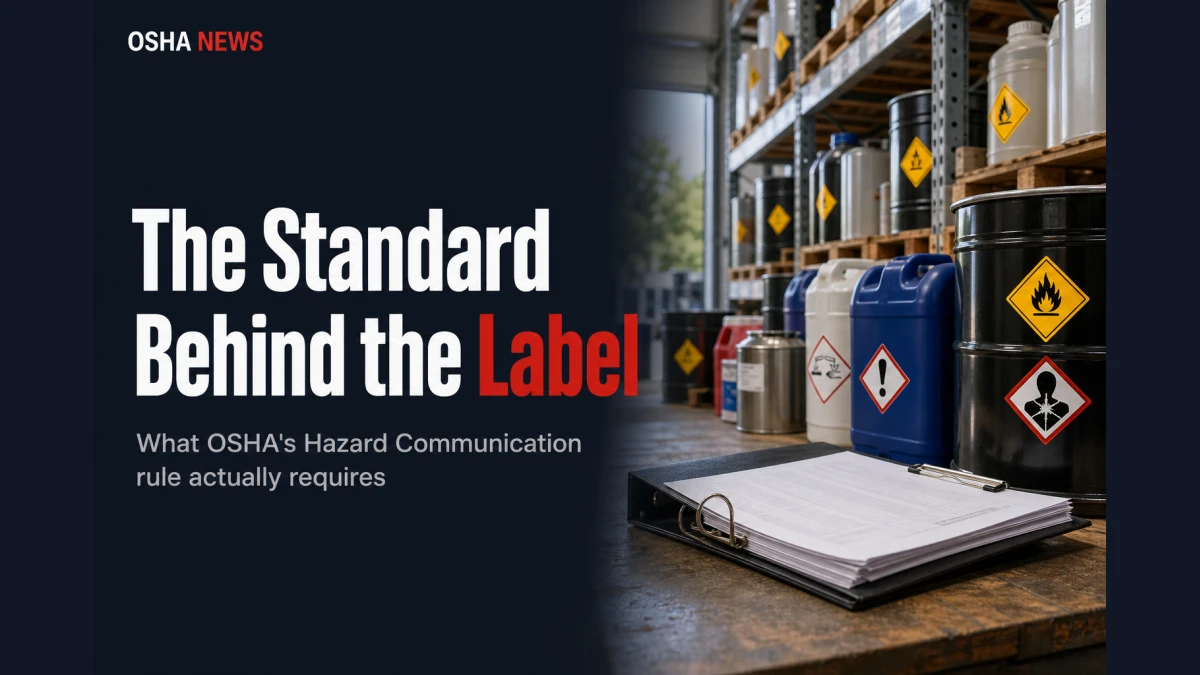
The OSHA Hazard Communication Standard, 29 CFR 1910.1200, is the federal rule requiring employers to tell workers what hazardous chemicals they're actually handling, through labels, safety data sheets, training, and a written program, before those chemicals hurt anyone. It is currently the second most-cited standard in all of federal OSHA enforcement, and in our own database of more than 13 million violations, it is the single most-cited standard of any kind: 682,792 citations and counting.
One real scope boundary worth knowing: this standard does not reach every hazardous workplace in the country. Mining is regulated entirely by a different federal agency, the Mine Safety and Health Administration, which enforces its own separate hazard communication rule under 30 CFR Part 47, not 29 CFR 1910.1200. That split exists because OSHA has no jurisdiction over mining at all, one of several real categories of work OSHA does not cover. ## What the Standard Actually Requires
1910.1200 rests on four requirements, and a real violation almost always traces back to one of them being missing, not all of them at once:
A **written hazard communication program** describing how the employer will meet the standard at that specific workplace: how containers get labeled, how safety data sheets are kept accessible, and how employees get trained, on paper, not just in someone's head.
**Container labeling**, covering every container of a hazardous chemical on site, whether it arrived from a manufacturer with a label already on it or was decanted into a secondary container in-house. A label has to carry a product identifier, the chemical's hazards, and appropriate pictograms, not just a handwritten name.
**Safety data sheets**, accessible to every employee who might be exposed, for every hazardous chemical in the workplace, in a 16-section format OSHA standardized in 2012. We cover what's actually in an SDS, section by section, in a companion piece.
**Employee training**, before an employee is first exposed to a hazardous chemical and again whenever a new hazard is introduced, covering how to read a label and an SDS, not just that they exist.
Why It Exists: The Right-to-Know Principle
The standard is built on a simple premise: a worker cannot protect themselves from a hazard they don't know is there. Before hazard communication existed as a unified federal rule, a worker's actual knowledge of what they were handling depended entirely on whether their specific employer happened to pass that information along, inconsistently, container by container, plant by plant. 1910.1200 makes that information a right, not a courtesy, standardized the same way across every covered workplace in the country.
The 2012 Overhaul: Aligning With a Global System
OSHA substantially revised 1910.1200 in March 2012, aligning it with the United Nations' Globally Harmonized System of Classification and Labeling of Chemicals (GHS), the first major overhaul of the standard since the original 1994 version. The final rule took effect May 25, 2012, standardizing hazard classification criteria, signal words, hazard statements, and the pictogram system now required on every label, the same symbols whether the chemical was made in the United States or imported from anywhere else in the world that has also adopted GHS. We break down each of the nine required pictograms, what they mean, and when each one applies, in a separate guide.
A Real Case: What Failure Actually Looks Like
Hazard communication is easy to describe as paperwork, a written program, a label, a data sheet, in the abstract. Mayer Repair LLC, an automotive shop in Sturtevant, Wisconsin, shows what it looks like when that paperwork fails in practice. A mechanic used a plasma cutter to open a sealed 55-gallon drum, with no reason to think it was anything other than empty scrap metal. It held flammable liquid instead. The explosion burned him across his abdomen, face, chest, and arms. He died eight days later.
OSHA's citations in that case went directly to the two hazard communication requirements that should have stopped it: the shop's written hazard communication program, and the labeling on the drum itself. Nothing told that worker what was actually inside the container before he reached for an open-flame tool. That is the entire purpose of this standard, stated as plainly as a real inspection record can state it.
What the Enforcement Data Actually Shows
Our own database, built from OSHA's complete public enforcement history, shows exactly how this standard gets enforced in practice, broken down by classification:
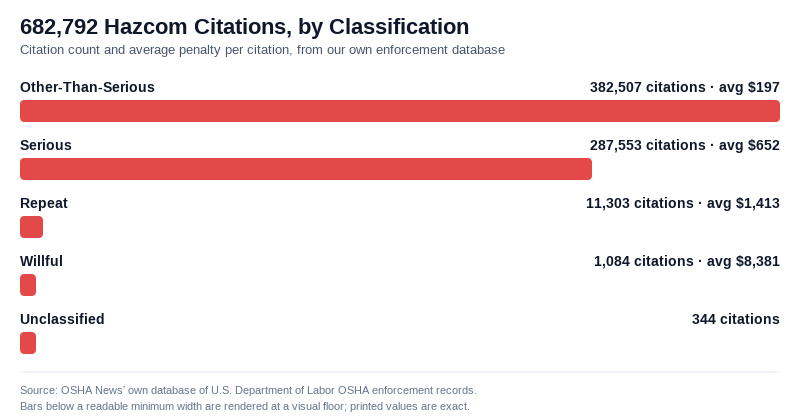
The gap between an Other-Than-Serious citation, averaging $197, and a Willful one, averaging $8,381, is not a rounding difference. It reflects a real legal distinction: Willful means OSHA found the employer acted with intentional disregard for, or plain indifference to, the standard, not an oversight. Repeat means OSHA already cited that employer, or a related one, for a substantially similar hazard communication failure before, at this location or another one, and it happened again anyway. A company looking at either of those classifications is looking at a citation that costs several times what a first-time, good-faith paperwork gap would.
What Real Compliance Looks Like
None of this requires inventing a compliance program from nothing. A written hazard communication program has to actually describe how labeling, SDS access, and training happen at that specific site, not a generic template nobody has read. Every container, including ones chemicals get transferred into in-house, needs a real label before anyone besides the person who filled it touches it. Safety data sheets need to be reachable by an employee at the moment they need one, not locked in an office that's closed when the second shift is working. And training has to happen before exposure, not after an inspector asks whether it did.
The Mayer Repair case is what happens when all of that exists on paper somewhere but didn't reach the one person who needed it before he picked up a torch.