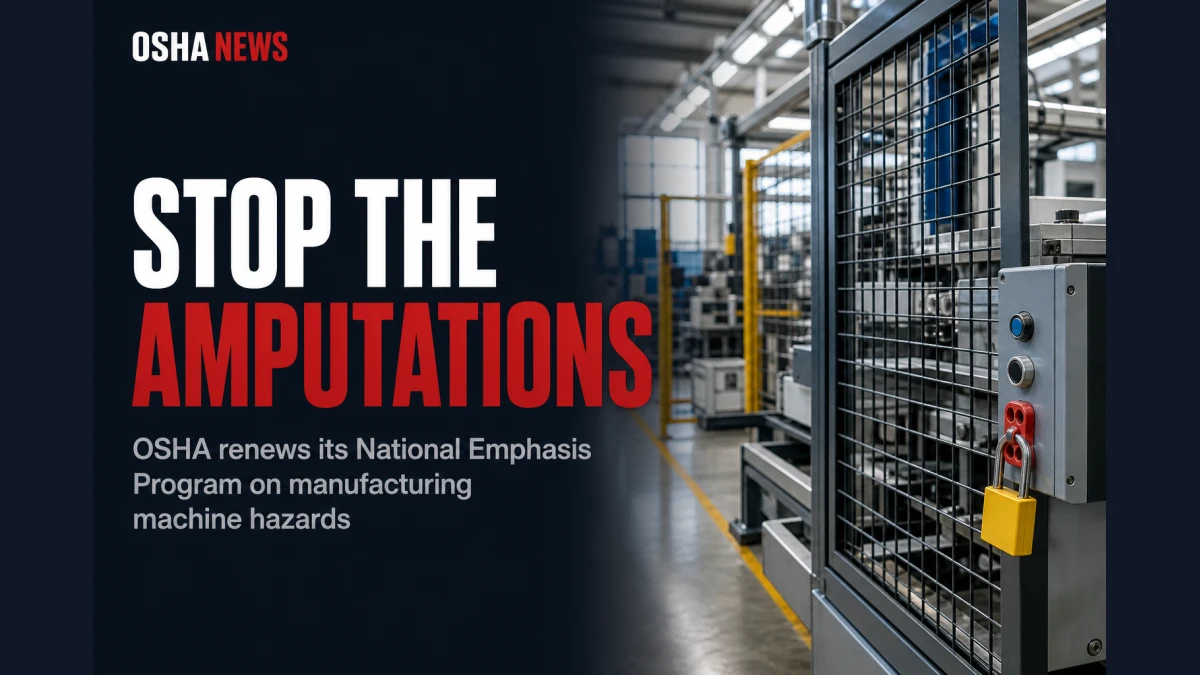
OSHA renewed its National Emphasis Program on Amputations in Manufacturing Industries, effective June 27, 2025, in place for five years. The directive, CPL 03-00-027, replaces the prior version (CPL 03-00-022, from December 2019) and keeps the agency's enforcement focus squarely on two things: machine guarding and lockout/tagout, the same two standards that, in our own enforcement database, together account for more citations and penalties than almost anything else we track.
What the Program Actually Targets
The renewed NEP directs OSHA compliance officers toward manufacturing facilities that use machinery capable of causing an amputation, an updated list of targeted industries by NAICS code, and specifically checks whether machines are properly guarded during operation, servicing, and maintenance, and whether hazardous energy sources are actually controlled (locked out) before anyone works on that equipment.
One real operational change in this version: a facility that was already inspected under the NEP within the previous 24 months, and didn't report an amputation in that window, can be removed from the programmed inspection list. That's a genuine incentive built into the enforcement mechanism itself, a clean recent inspection record can mean fewer future unannounced visits under this specific program, not a loosening of the underlying guarding or lockout requirements.
The Two Standards This NEP Actually Enforces
Machine guarding (29 CFR 1910.212) and lockout/tagout (29 CFR 1910.147) aren't abstract regulatory categories here, they're the two standards an amputation-focused inspection actually checks.
In our own enforcement database, 1910.212 carries 331,088 citations and $289,294,606 in total penalties. 1910.147 carries even more: 244,344 citations and $350,347,553 in penalties, the single largest dollar figure of any standard in our full historical records. We've written a detailed explainer on the real 8-step lockout procedure directly from OSHA's own Appendix A, since a lot of training content online describes the sequence incorrectly, compressing it into 5 or 7 steps instead of the eight OSHA's own appendix actually lists.
Why These Two Standards Go Together
An amputation on a piece of manufacturing machinery almost always traces back to one of two failures: the machine's moving parts weren't physically guarded against contact in the first place, or someone serviced, cleared a jam from, or cleaned a machine that was never actually isolated from its energy source before they reached into it. OSHA's own NEP structure reflects that: it doesn't treat machine guarding and lockout/tagout as separate enforcement priorities, it checks both together, because in practice an amputation hazard is rarely just one or the other.
What This Means If You Run a Manufacturing Facility
A facility matching this NEP's targeted NAICS codes should expect that an OSHA inspection, if one happens, will specifically examine whether every point of operation and every moving part that could catch a hand, arm, or clothing is actually guarded, not just marked with a warning label, and whether the written lockout/tagout program is both real and followed, not just a document that exists somewhere in a binder. The 24-month clean-inspection exemption built into this version means the facilities most likely to see a repeat visit are the ones that either haven't been inspected under this NEP recently, or were inspected and something was found.