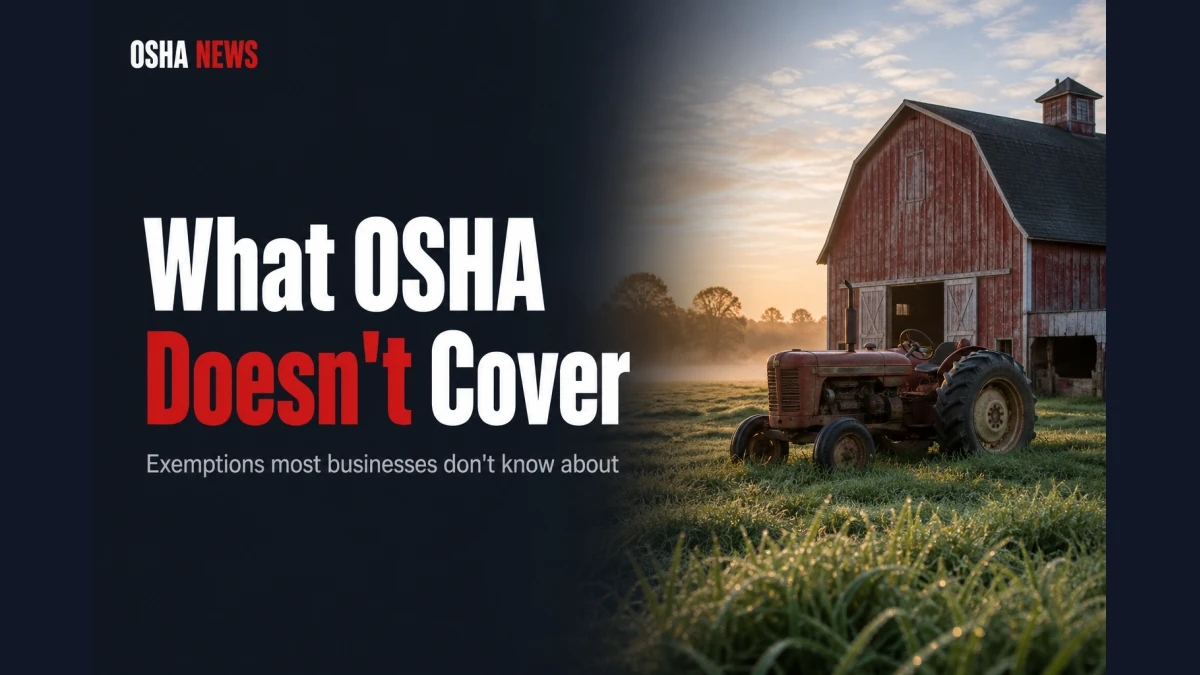
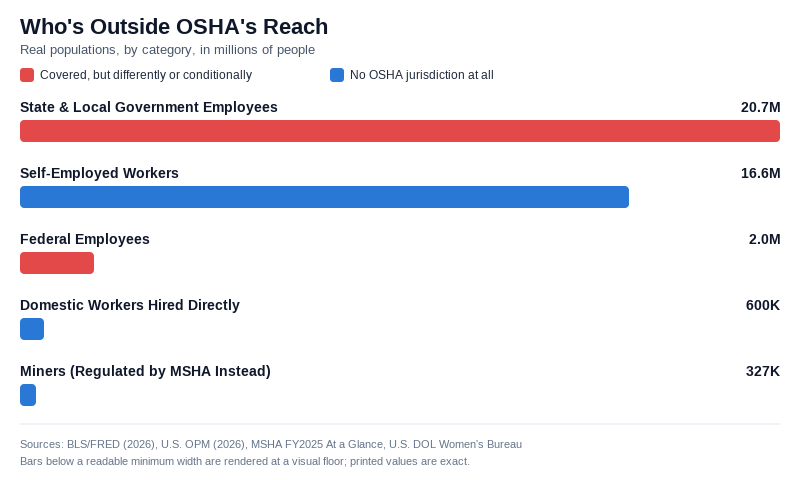
OSHA's name promises universal coverage, the Occupational Safety and Health Administration, as if every job in the country answers to it. In reality, OSHA does not cover every job. Real, specific categories of work sit entirely outside its reach, by law, not by oversight. Put the biggest ones together and you're looking at more than 40 million workers, roughly the combined population of California and Texas, who can't rely on federal OSHA the way most private-sector employees can, either because it has zero jurisdiction over their job or because its enforcement works differently for them.
If You Work for Yourself, OSHA Was Never Written to Cover You
The Occupational Safety and Health Act defines an "employer" as someone who has employees. A true sole proprietor, nobody on payroll but themselves, doesn't meet that definition, so there's no "employer" for the Act to regulate in the first place. This isn't a loophole somebody found later; it's baked into the statute's own language.
The scale of this is easy to underestimate. Bureau of Labor Statistics data from early 2026 puts unincorporated, non-agricultural self-employment at roughly 9.2 million people, with another 6.7 million self-employed through an incorporated business and 757,000 more in agriculture. Add it up and you get roughly 16.6 million self-employed workers, a population bigger than most U.S. states, operating with zero OSHA jurisdiction over how they do their own job.
Family Farms Get Two Different Exemptions, Not One
A farm that employs only the immediate members of the farmer's own family isn't covered by the Act at all, separate from any question of size. That's a narrow, specific exclusion: the moment a farm brings in even one worker who isn't immediate family, this particular exemption stops applying.
A second, broader exemption covers far more ground and has nothing to do with family. Since 1976, a federal budget rider has blocked OSHA from spending any appropriated funds enforcing its rules against a farm with 10 or fewer employees, related or not, as long as that farm hasn't maintained a temporary labor camp in the past 12 months. This is the exemption behind the small-farm carve-out we researched for our own Maritime & Agriculture regulations guide, and it's done through Congress's spending power, not the Act itself, which is why it can be narrower or broader depending on how each year's appropriations bill is written.
The Federal Government Can Be Cited. It Can't Be Fined.
Federal employees are covered, just not the way private-sector workers are, and there are roughly 2 million of them across the executive branch as of 2026. Executive Order 12196 and Section 19 of the OSH Act put federal agencies under OSHA's inspection and citation authority, carried out through 29 CFR 1960. OSHA can walk into a federal workplace, find a violation, and issue a citation for it.
What OSHA cannot do is fine that agency. There's no monetary penalty available against the federal government the way there is against a private employer, which means the single biggest lever OSHA has against a private company, the number attached to every citation we cover on this site, simply doesn't exist here. The accountability mechanism is citation and corrective action, not cost.
State and Local Government Workers Depend Entirely on Where They Live
The Act's own definition of "employer" excludes the United States and any state or political subdivision of a state. Read literally, that means a municipal police officer, a city firefighter, a public school custodian, or a county road crew has no federal OSHA coverage at all, regardless of what happens on the job. This is the single largest group affected by any exemption on this list: 20.7 million people work for state and local governments nationwide as of May 2026, per BLS data, more than the self-employed and federal workforces combined.
In practice, coverage depends entirely on which state that worker is in. States that run their own OSHA-approved State Plan can choose to extend coverage to their own public employees, and many do. We've already reported on a real example of this: the Linden Roselle Sewerage Authority, a public utility in New Jersey, was cited under New Jersey's own public-employee occupational safety law, not federal OSHA, because federal OSHA simply has no jurisdiction over a public employer in that state at all. A public worker in a state without that kind of plan has no equivalent protection to point to.
When a Different Federal Agency Already Owns the Hazard
Section 4(b)(1) of the Act carves out working conditions that another federal agency already has the statutory authority to regulate and has actually used that authority on. Courts and OSHA's own review commission apply it as a two-part test: does the other agency have the legal authority, and has it actually exercised that authority over this specific condition, not just the general industry.
Three real examples show how differently this plays out depending on the hazard:
**Mining** gets no OSHA jurisdiction at all, regardless of a mine's size or the specific hazard involved. The Federal Mine Safety and Health Act hands that entire field to the Mine Safety and Health Administration, which reported 327,465 miners across coal and metal/nonmetal operations in fiscal year 2025, a separate agency with its own inspectors, its own penalty structure, and its own case law, completely outside OSHA's reach.
**Aviation maintenance** is narrower. The FAA's own maintenance-manual safety instructions for aircraft mechanics have been held by OSHA's review commission to preempt OSHA's rules specifically where the FAA has actually written a requirement covering that exact task, not aviation work in general.
**Maritime work** is narrower still. Coast Guard regulations under 46 CFR Chapter I preempt OSHA only for the specific working conditions the Coast Guard has actually regulated on navigable waters, which means a vessel can have some conditions under Coast Guard authority and others still under OSHA's, on the same ship, the same day.
OSHA Doesn't Cover Who You Hire to Clean Your Own House
If you personally hire someone to clean your home, cook, or care for your children, directly, as a homeowner, OSHA doesn't cover that work relationship under 29 CFR 1975.6. The same holds for a home health aide hired directly to care for an elderly family member. The U.S. Department of Labor's own Women's Bureau puts the number of domestic workers employed directly by private households, not through an agency, at more than 600,000 people nationally.
That line moved in at least one state recently, which makes the federal rule easier to see by contrast. California's SB 1350, effective July 2025, extended the state's own workplace safety protections to domestic workers employed by a business, a housecleaning company or a home-care agency, while leaving a homeowner's own direct hire outside coverage even under the new state law. The business-employed version of the exact same job is covered. The homeowner-employed version still isn't, in California or anywhere else.
Why This Matters Beyond the Trivia
None of this is OSHA failing to do its job. Every exemption above traces back to a specific, deliberate legislative choice: a statutory definition of "employer," a 50-year-old budget rider, an executive order building a parallel system for federal agencies, or Congress handing an entire hazard category to a different agency by name. The pattern underneath all of it is the same: OSHA's authority was drawn with real, intentional edges, and knowing exactly where those edges sit tells you whether a worker has real federal recourse or needs to look somewhere else entirely, a state agency, a different federal regulator, or nothing at all.