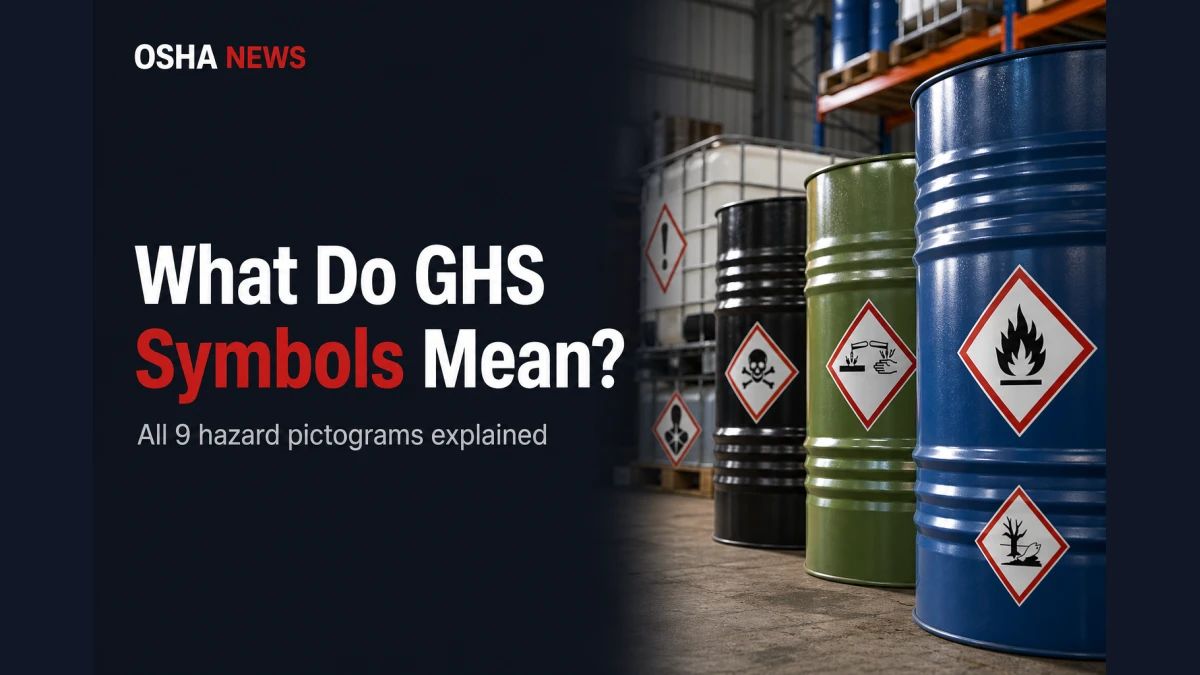
Nine pictograms, instantly recognizable red-bordered diamonds, cover every hazard class OSHA's labeling rules are built to warn about, and eight of them are mandatory on a hazardous chemical's label today. They exist because a worker who can't read the written warning on a container, whether from a language barrier, poor lighting, or simply never having been trained on it, can still recognize a flame or a skull and crossbones. That's not a hypothetical. A real OSHA case on this site shows exactly what happens when that system fails: a worker who had no idea what was inside a sealed drum before he cut into it.
Why These Symbols Exist at All
OSHA's Hazard Communication Standard, 29 CFR 1910.1200, was rewritten in 2012 to align with the United Nations' Globally Harmonized System of Classification and Labeling of Chemicals, a single international standard for how a chemical's hazards get classified and communicated instead of every country inventing its own. As of June 1, 2015, OSHA's own HazComm Quick Card confirms, every label on a hazardous chemical had to carry the correct pictogram for its hazard classification. Each pictogram is a symbol on a white background, framed in a red border, in a diamond orientation, a shape and color combination that doesn't exist anywhere else on a typical label, so it reads as a warning before anyone reads a single word.
What Happens When the System Fails
Mayer Repair LLC, an automotive shop in Sturtevant, Wisconsin, is a real, documented case of exactly this failure. A mechanic used a plasma cutter on a sealed 55-gallon drum, with no reason to think it was anything but empty scrap metal. It held flammable liquid. The explosion that followed killed him eight days later. OSHA's citations trace the failure back to a hazard communication program that didn't function, drums moving through a workplace without the labeling, including the Flame pictogram, that should have told him what was inside before he ever reached for the cutter. That pictogram exists for precisely this situation: a worker encountering a container with no time to read a paragraph of text, who needs the hazard to be legible at a glance.
The Nine Pictograms and What Each One Means
OSHA's own classification is the authority here, not a paraphrase of it. Eight of the nine are mandatory; the ninth, Environment, is not required on a U.S. label but still appears on some products built to one global specification.
**Health Hazard.** Carcinogen, mutagenicity, reproductive toxicity, respiratory sensitizer, target organ toxicity, aspiration toxicity. This is the pictogram for a chemical that causes serious internal harm over time, not an immediate, visible injury.
**Flame.** Flammables, pyrophorics, self-heating substances, substances that emit flammable gas, self-reactive substances, organic peroxides. This is the pictogram that should have been on the drum in Sturtevant.
**Exclamation Mark.** Irritant to skin and eyes, skin sensitizer, acute toxicity classified as harmful (not fatal), narcotic effects, respiratory tract irritant, and, as a non-mandatory category, hazardous to the ozone layer. This is the pictogram for real but less severe hazards than the ones carrying Health Hazard or Skull and Crossbones.
**Gas Cylinder.** Gases under pressure, whether compressed, liquefied, dissolved, or refrigerated.
**Corrosion.** Skin corrosion and burns, eye damage, and corrosive to metals, a pictogram that covers both what a chemical does to a person and what it does to the container or equipment holding it.
**Exploding Bomb.** Explosives, and also certain self-reactive substances and organic peroxides when their specific hazard category calls for it rather than the Flame pictogram.
**Flame Over Circle.** Oxidizers, substances that can intensify a fire even though they are not themselves flammable.
**Skull and Crossbones.** Acute toxicity that is fatal or otherwise seriously toxic, the pictogram reserved for the most severe short-term toxicity categories.
**Environment (non-mandatory).** Aquatic toxicity. OSHA does not require this one on a U.S. label, since environmental hazard communication falls more squarely under other agencies' jurisdiction, but it remains part of the full GHS set and can still appear.
A Pictogram Is Only One Part of a Real Label
The red-bordered diamond is the part people recognize fastest, but it's never the only thing a compliant label carries. A real GHS-aligned label also has a signal word, either "Danger" for the more severe hazard categories or "Warning" for less severe ones, a specific hazard statement describing the exact hazard in plain language, and precautionary statements describing what to do about it. The pictogram tells a worker to pay attention at a glance; the words next to it tell them exactly why. A Safety Data Sheet for the same chemical carries the full version of all of this, including which pictograms apply and why, which is why OSHA requires both the label and an accessible SDS, not one or the other.
Why This Still Shows Up in Real Enforcement
Hazard communication citations are not rare or theoretical. They are consistently among the most frequently cited standards in OSHA's enforcement history, across every industry, not just chemical manufacturing, a pattern laid out in full in OSHA's hazard communication requirements. A missing or incorrect pictogram is a small-looking paperwork gap until it's the one piece of information standing between a worker and a container they're about to cut, pour, or heat.