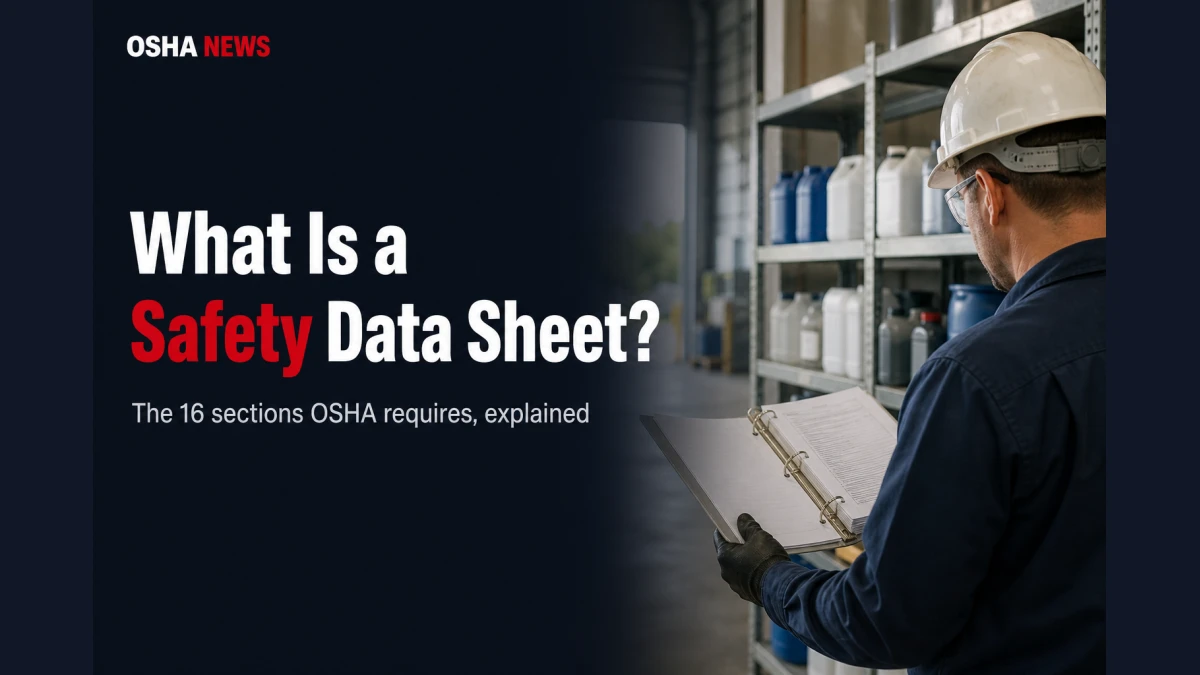
A Safety Data Sheet, almost always just called an SDS, is the document OSHA requires for every hazardous chemical in a U.S. workplace: what it is, how it can hurt someone, and what to do if it does. It used to be called a Material Safety Data Sheet, or MSDS, and most people who've worked around chemicals for more than a few years still call it that out of habit. The name changed in 2012. The job it does didn't.
Why MSDS Became SDS
Before 2012, a Material Safety Data Sheet could look like almost anything. One manufacturer's MSDS might run two pages; another's might run twenty, organized in whatever order that company's own format happened to use. A worker moving between employers, or even between two chemicals made by two different suppliers, had to relearn the document's layout every time.
In March 2012, OSHA revised the Hazard Communication Standard, 29 CFR 1910.1200, to align with the United Nations' Globally Harmonized System of Classification and Labelling of Chemicals, known as GHS. The revision became effective May 25, 2012, the same date the agency formally renamed the document from MSDS to SDS and locked it into one standardized 16-section format that every chemical manufacturer and importer in the country now has to follow, specified in Appendix D of 29 CFR 1910.1200. A worker who learns the format once can read any SDS for any chemical, from any supplier, and know exactly where to find the information that matters.
What an SDS Looks Like in Practice
A real example shows why the format matters more than it sounds like it should. In Sturtevant, Wisconsin, a mechanic at Mayer Repair LLC used a plasma cutter to open what he believed was an empty 55-gallon scrap drum. It wasn't empty. It held flammable liquid, and the instant the cutter touched the metal, the drum exploded. He died eight days later from his injuries. OSHA's investigation found a hazard communication program that existed on paper but didn't function the way the standard requires, a container that reached a worker's hands without the information that should have come with it. A correctly prepared, actually accessible SDS for whatever that drum once held, cross-referenced against a label that identified its contents, is precisely the thing that tells a worker what's inside a container before he reaches for an open flame.
The 16 Required Sections
Every SDS has to follow the same 16-section order. OSHA enforces the content of Sections 1 through 11 and Section 16. Sections 12 through 15 have to be present, to keep the document consistent with the UN's GHS, but OSHA doesn't enforce what's written inside them, since the information they cover (shipping, environmental fate, disposal) falls under other federal agencies, not OSHA.
1. **Identification.** The chemical's name, the manufacturer's contact information, an emergency phone number, and its recommended use. 2. **Hazard(s) Identification.** The hazard classification, the signal word ("Danger" or "Warning"), hazard statements, and the pictograms that have to appear on the label too. 3. **Composition/Information on Ingredients.** The chemical name, CAS number, and concentration of each hazardous ingredient, with specific, narrow exceptions that allow a concentration range instead of an exact percentage (a genuine trade-secret claim, batch-to-batch variation, or a single SDS covering a group of closely related mixtures). 4. **First-Aid Measures.** What to do immediately after inhalation, skin contact, eye contact, or ingestion, and what symptoms to watch for. 5. **Fire-Fighting Measures.** What extinguishing equipment actually works on this chemical, what doesn't, and what hazards show up specifically when it burns. 6. **Accidental Release Measures.** How to respond to a spill or leak: containment, cleanup method, and the personal protective equipment needed to do it safely. 7. **Handling and Storage.** Safe handling practices, incompatible materials to keep away from it, and storage conditions. 8. **Exposure Controls/Personal Protection.** OSHA's own Permissible Exposure Limits, ACGIH Threshold Limit Values where they apply, required engineering controls, and the specific PPE needed, down to the glove material in some cases. 9. **Physical and Chemical Properties.** Appearance, odor, pH, boiling and melting point, flash point, flammability limits, vapor pressure and density, solubility, and viscosity. 10. **Stability and Reactivity.** Whether the chemical is stable under normal conditions, what it reacts dangerously with, and what hazardous byproducts it can decompose into. 11. **Toxicological Information.** Routes of exposure, acute and chronic health effects, numerical toxicity data such as LD50 values, and whether the chemical is listed as a carcinogen by the National Toxicology Program, IARC, or OSHA itself. 12. **Ecological Information** (present for GHS alignment, not OSHA-enforced). Toxicity to aquatic and terrestrial life, and how persistent the chemical is in the environment. 13. **Disposal Considerations** (present for GHS alignment, not OSHA-enforced). Safe disposal methods and container handling. 14. **Transport Information** (present for GHS alignment, not OSHA-enforced). UN number, proper shipping name, and transport hazard class. 15. **Regulatory Information** (present for GHS alignment, not OSHA-enforced). Other federal regulations that apply, under agencies like the Department of Transportation, the EPA, or the Consumer Product Safety Commission. 16. **Other Information.** The date the SDS was prepared or last revised, and a summary of what changed since the previous version.
Keeping an SDS Within Reach Isn't Optional
The Hazard Communication Standard doesn't just require that an SDS exist somewhere in a filing cabinet at corporate. Employers have to keep safety data sheets readily accessible to every employee who might be exposed to that chemical, in their actual work area, not behind a closed office door down the hall. A binder on the shop floor and a digital copy on a shared computer both satisfy this, as long as a worker can reach the information without leaving their work area, and as long as there's a backup plan for reading it if the power goes out. If an employer doesn't have an SDS for a chemical in the building, the standard puts the responsibility on them, or whoever they designate, to contact the manufacturer and get one, not to wait until something goes wrong to ask.
Why the Format Itself Is the Point
A 16-section SDS can look like bureaucratic overhead until the moment someone actually needs Section 4 or Section 11 in a hurry. The entire reason OSHA locked the format down in 2012, rather than leaving it to each manufacturer's own judgment, is so that a worker under pressure, someone who's just been splashed with an unknown liquid or is trying to decide whether a container is safe to cut into, can flip to the same section number every time and find the same kind of information, regardless of who made the chemical. The Sturtevant case shows what happens when that system doesn't reach the person who needed it. The format exists so that it does.
A safety data sheet never stands alone. It exists because the Hazard Communication Standard, 29 CFR 1910.1200 requires it, and the labels on the container it describes use the same GHS hazard pictograms a worker should already recognize before ever opening the binder.