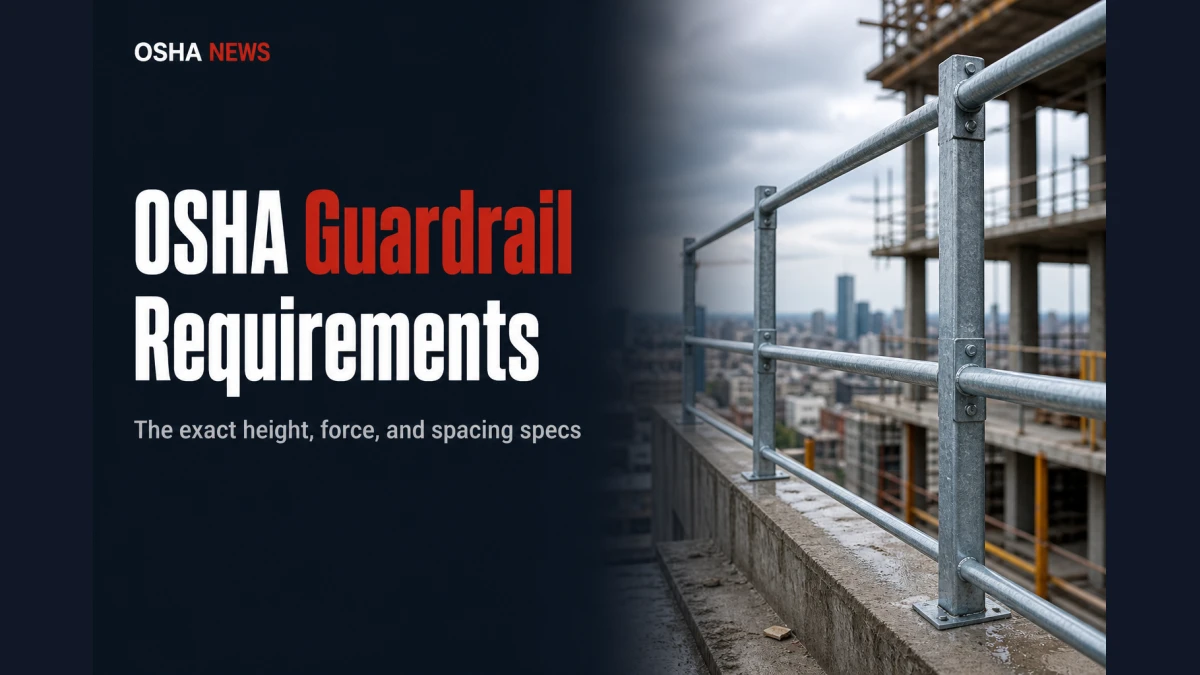
A compliant OSHA guardrail isn't just a rail bolted to an edge. Under 29 CFR 1926.502(b), the construction guardrail standard, the top rail has to sit 42 inches above the walking surface, give or take 3 inches, and it has to survive at least 200 pounds of force without failing. A rail that's merely present but can't take that load doesn't meet the standard, even if it looks fine from a distance.
The Exact Numbers, Cited to the Exact Subsection
1926.502(b)(1) sets the top rail height at 42 inches (1.1 m), plus or minus 3 inches (8 cm), above the walking/working level. 1926.502(b)(3) requires the top rail to withstand, without failure, a force of at least 200 pounds (890 N) applied within 2 inches of the top edge, in any outward or downward direction. A midrail is required too: 1926.502(b)(2)(i) places it midway between the top rail and the working surface, and 1926.502(b)(5) requires it to withstand at least 150 pounds (666 N) of force. Gaps matter as well: 1926.502(b)(2)(iii) and (b)(2)(iv) cap the opening between any intermediate members, such as balusters, at no more than 19 inches. A separate provision, 1926.502(j)(3), requires toeboards at least 3.5 inches tall with no more than a quarter-inch gap above the working surface, when falling objects are a hazard below.
Why 200 Pounds Specifically
The 200-pound figure isn't arbitrary. It reflects the real force a person applies when they stumble, lean hard, or fall against a rail, not the gentle pressure of resting a hand on it. A guardrail that looks sturdy but was never built or anchored to actually withstand that load provides the appearance of fall protection without the substance of it, which is exactly the gap this standard exists to close.
A Real Case: The Rail That Couldn't Hold
Highrise Safety Systems, Inc., a contractor working an 8th-floor edge at a Hoboken, New Jersey high-rise, was cited specifically under 1926.502(b)(3): the guardrail system installed at the edge could not withstand the required 200 pounds of force, exposing workers to a fall of roughly 80 feet. That citation alone carried a $14,895 penalty, classified Serious, and was not contested; it became a final order on August 31, 2026. The company's own name made the gap between paperwork and performance plain: a guardrail present, inspected, and still unable to do the one thing the standard requires of it.
Construction Guardrails Are Not the Same Standard as General Industry Guardrails
1926.502(b) applies to construction work under Subpart M. A separate standard, 1910.29, covers guardrails in general industry workplaces, factories, warehouses, and fixed facilities, under its own Subpart D. The two standards cover similar ground but are not identical, and a company operating in both construction and general industry settings needs to check which one actually applies to a given worksite rather than assuming one set of numbers covers everything. Our General Industry regulations guide and Construction regulations guide cover each standard's own full requirements separately.
A guardrail is a passive system: it prevents a fall from starting in the first place. It is one piece of the broader OSHA fall protection standard, and where a guardrail is not feasible, the active alternative is a personal fall arrest system, which catches a worker already in a fall rather than preventing it.