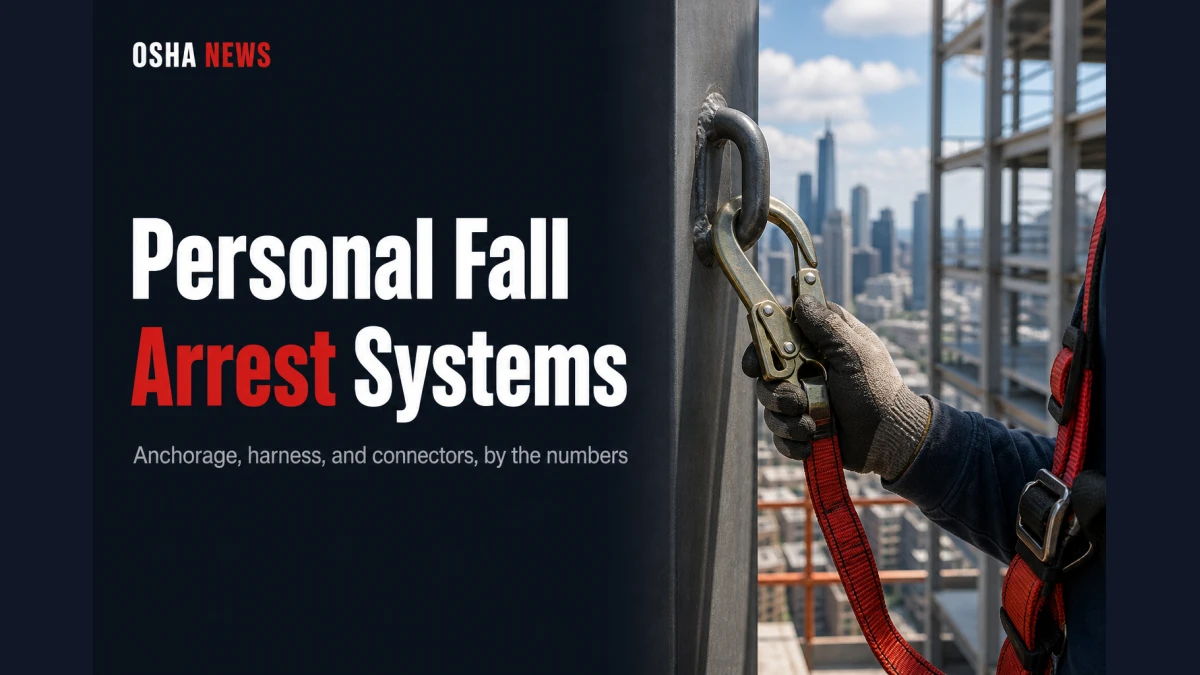
A personal fall arrest system is the equipment that catches a worker already falling, not the equipment that keeps them from falling in the first place. OSHA's own definition, in 29 CFR 1926.500, describes it precisely: a system that consists of an anchorage, connectors, and a body belt or body harness, and may also include a lanyard, deceleration device, lifeline, or a combination of these. When it works, it has to stop a real fall within strict, numeric limits: no more than 6 feet of free fall, no more than 1,800 pounds of force on the worker's body, and a complete stop within 3.5 feet of deceleration.
The Three Required Parts, and the Ones That Are Optional
OSHA's definition is specific about what's mandatory and what isn't. Every personal fall arrest system must have an anchorage, connectors, and a body belt or body harness. A lanyard, deceleration device, and lifeline are described as components the system "may include," added as needed depending on the job, not a fixed universal checklist. That distinction matters for anyone trying to understand what a compliant system actually requires versus what a specific jobsite happens to be using.
**Anchorage** is defined as a secure point of attachment for lifelines, lanyards, or deceleration devices, and it has to be capable of supporting at least 5,000 pounds per employee attached to it.
**Connectors** are the hardware, D-rings, snaphooks, and similar devices, that join the other parts of the system together, and OSHA sets specific strength and locking requirements for them.
**A body harness** distributes the force of a fall across the thighs, pelvis, chest, and shoulders. It is the only body support OSHA allows in a personal fall arrest system today.
**A lanyard** is a flexible line, rope, wire rope, or strap, usually with a connector at each end, linking the harness to a deceleration device, lifeline, or anchorage. **A lifeline** is a flexible line connected to an anchorage, either hanging vertically or stretched horizontally between two anchorages, that other components attach to. **A deceleration device** is any mechanism, a rope grab, a rip-stitch lanyard, an automatic self-retracting lifeline, that dissipates energy during the fall to keep the arresting force survivable.
The Numbers That Actually Define "Compliant"
29 CFR 1926.502(d) sets hard engineering limits on what a personal fall arrest system is allowed to do to the human body during a real fall:
- Maximum arresting force: **1,800 pounds (8 kN)** when used with a body harness. - Maximum free fall distance: an employee may not free fall more than **6 feet (1.8 m)**, and may not contact any lower level at all. - Maximum deceleration distance: the system must bring the employee to a complete stop within **3.5 feet (1.07 m)**. - Minimum breaking strength for lanyards and vertical lifelines: **5,000 pounds (22.2 kN)**. - Minimum anchorage capacity: **5,000 pounds (22.2 kN)** per employee attached.
These aren't rounded estimates. They're the specific thresholds an inspector checks a system against after an incident, and the reason a harness, lanyard, or anchor point bought off a shelf still has to be rated and used correctly to actually meet the standard.
Why Body Belts Were Banned
The regulation says it plainly: "Effective January 1, 1998, body belts are not acceptable as part of a personal fall arrest system." A belt that wraps only around the waist concentrates the force of a fall arrest on the abdomen, which can cause serious internal injury even when the fall itself is survived. A full body harness spreads that same force across the thighs, pelvis, chest, and shoulders instead, which is why it's the only body support option the standard allows now.
A Real Case: When a Connector Fails
A personal fall arrest system is only as reliable as its weakest real component, and our own coverage already has a case showing exactly that. At a high-rise jobsite in Hoboken, New Jersey, OSHA found a vertical lifeline on the 9th floor deck that had been damaged by nails, driven through it by employees of a different contractor working the same site, who were trying to keep the lifeline's self-retracting device from pulling loose. A punctured lifeline is exposed to being cut or abraded at exactly the point someone might need it to hold. The same inspection also found a guardrail that couldn't withstand the required 200 pounds of force, a separate, passive fall protection system failing alongside the active one. Four citations followed, and none were contested.
Personal Fall Arrest vs. Guardrails: Two Different Jobs
A personal fall arrest system is active protection: it does nothing until a fall is already happening, then catches it. A guardrail system is passive protection: it's supposed to prevent the fall from starting at all. OSHA's broader fall protection standard treats both as acceptable methods depending on the job, and a single site can legitimately use guardrails in one area and personal fall arrest systems in another. Confusing the two, or assuming one makes the other unnecessary, is exactly the kind of gap that shows up in real citations.