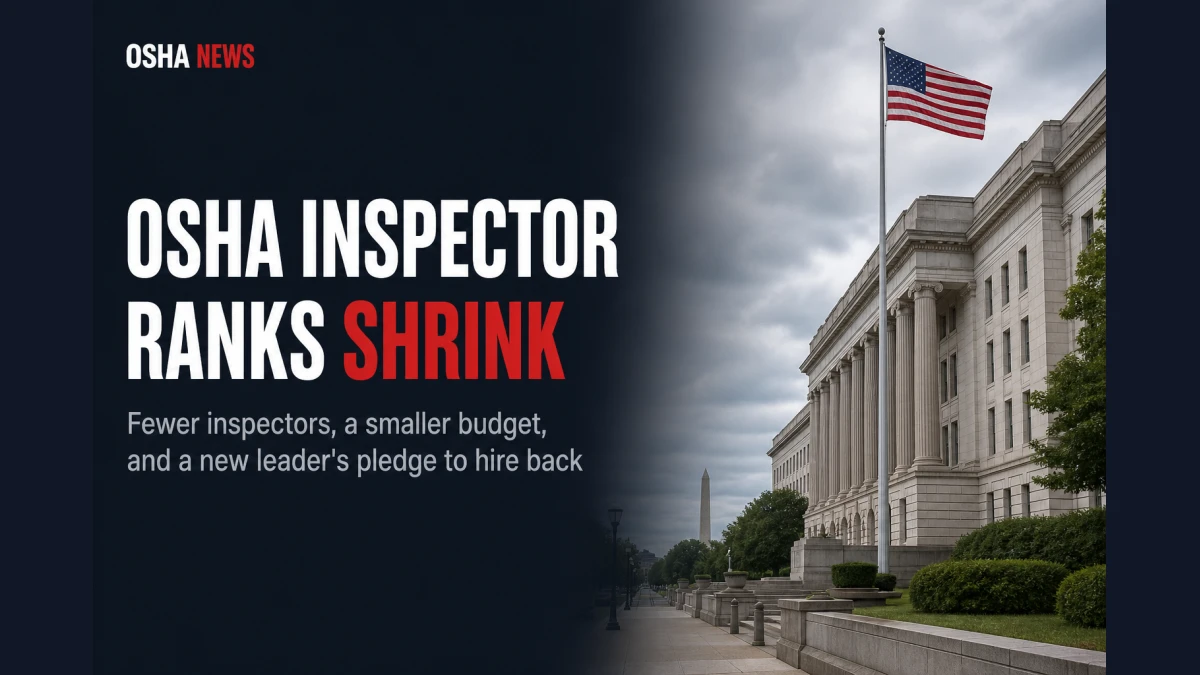
OSHA's own staffing numbers show a real decline: the agency's federal inspector corps fell from 846 in February 2024 to 736 in June 2025, according to the Department of Labor's Office of Inspector General. Separately, OSHA's own personnel data shows the agency lost more than 180 federal safety inspectors between fiscal year 2024 and fiscal year 2025. Workplace inspections fell roughly 20% between April and September 2025, per Bloomberg Law reporting. The agency's newly confirmed leader says reversing that is now his top priority.
The Numbers
Three separate data points, from three separate sources, point the same direction. The DOL Inspector General's count shows 110 fewer federal inspectors between February 2024 and June 2025. OSHA's own personnel figures, as reported by Bloomberg Law, show a loss of more than 180 inspectors across fiscal year 2024 to fiscal year 2025, a different measurement window than the IG's count, so the two numbers describe overlapping but not identical periods rather than contradicting each other. Inspections themselves fell approximately 20% from April through September 2025.
The administration's fiscal year 2026 budget request proposed cutting OSHA's overall budget to roughly $582.4 million, down from $632.3 million, an 8% reduction.
Lawmakers Took Notice
In February 2026, Senator Elizabeth Warren and five other Senate Democrats sent a letter to OSHA raising concerns over the decline, stating that in the administration's first nine months, OSHA brought 35% fewer enforcement cases and imposed 47% lower penalties than the comparable prior period.
The Agency's Response
David Keeling, confirmed by the Senate as Assistant Secretary of Labor for Occupational Safety and Health on October 6, 2025 in a 51-47 vote alongside dozens of other administration nominees, told Bloomberg Law he wants to fill the roughly 180 vacant inspector positions the agency currently carries. "Workplace safety is a national health crisis, and we need to approach it like that," Keeling said.
Keeling, who spent 37 years in occupational safety roles at UPS before his nomination, has described his approach as balancing enforcement with what he calls industry cooperation, helping small and mid-size employers understand compliance requirements rather than relying solely on citations to drive behavior.
What This Means for Employers
A smaller inspector corps does not mean the underlying standards have changed. Every requirement covered elsewhere on this site, from hazard communication to lockout/tagout to fall protection, remains fully enforceable, and a smaller inspection footprint has historically meant OSHA prioritizes its highest-risk targets, like the industries covered under its active National Emphasis Programs, rather than a random cross-section of workplaces. Whether Keeling's stated hiring priority actually closes the gap is something this site will track as new inspector numbers are reported.